Digital Solutions Specialist Singapore

Website Developer for Healthcare Clinics in Singapore: What Matters Most
September 8, 2026
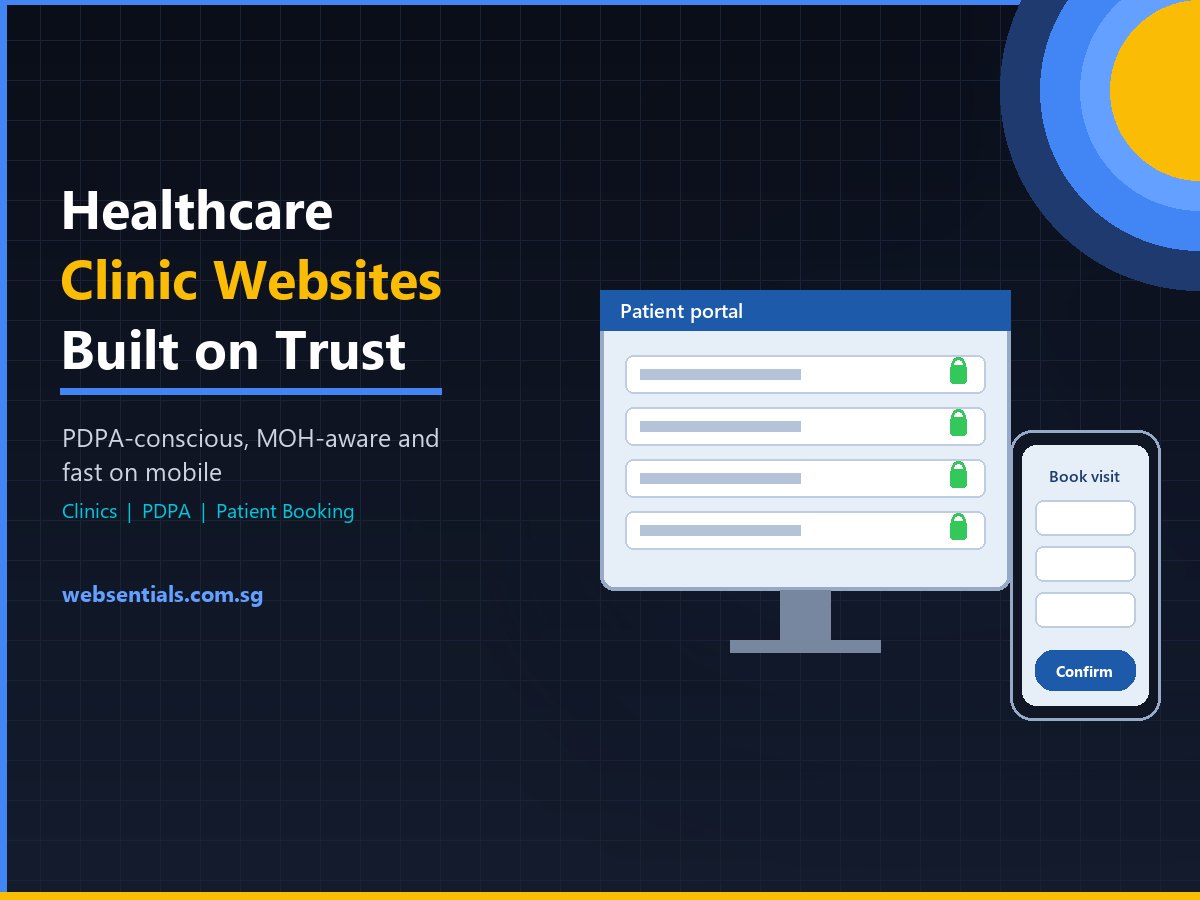
A website developer for healthcare clinics in Singapore needs to understand more than web design: PDPA-compliant data handling, MOH advertising rules, fast mobile booking and visible medical credentials all matter more in healthcare than in almost any other industry. Websentials is a Singapore-based web development and digital marketing agency that has worked directly with dental, physiotherapy and medical clinics on exactly these needs.
Why Healthcare Websites Are Different
In healthcare, trust is everything. Before a patient steps into your waiting room, they have already judged your clinic’s professionalism online. If your site takes five seconds to load, shows security warnings or has a clunky mobile booking form, patients may unconsciously assume the same carelessness applies to your care.
Building a clinic website in Singapore is also a regulated discipline. Licensed healthcare providers must follow the Ministry of Health’s advertising rules under the Healthcare Services Act (HCSA), and any system that collects patient information must comply with the Personal Data Protection Act (PDPA), which the PDPC explains in its advisory guidelines for the healthcare sector [1].
Treating a clinic website like a retail brochure is a real operational risk. An off-the-shelf template won’t support a secure patient portal or the role-based access control (RBAC) needed to keep patient data away from staff who don’t need it. Clinics need a web development agency in Singapore that understands local healthcare requirements and builds infrastructure that protects patient privacy and the clinic’s liability.
Standard SME Website vs. Compliant Healthcare Clinic Website
| Area | Standard SME website | Compliance-ready clinic website | Impact for the clinic |
|---|---|---|---|
| Data security | Basic SSL certificate | Encryption in transit and at rest, plus RBAC and audit logs | Reduces PDPA breach risk and protects patient trust |
| Content & copy | Sales-driven marketing copy | Factual, educational and HCSA-aware | Avoids MOH advertising breaches and keeps a professional tone |
| Booking | Simple email contact forms | Secure booking forms or an integrated patient portal | Protects NRIC/FIN data and cuts admin work |
| Visuals | “Before and after” galleries | Compliant imagery with no before/after marketing | Follows MOH restrictions on treatment imagery |
| Database | Shared hosting and plugin-heavy setups | Isolated, dedicated corporate CMS | Keeps patient data separate from the public website |
What Healthcare Clinics Need From a Website and Marketing Partner
1. PDPA Compliance and Secure Patient Data
Any platform that collects patient names, contact numbers, NRICs or medical details must comply with the PDPA. Contact forms that email unencrypted data to a shared clinic inbox are a serious weakness.
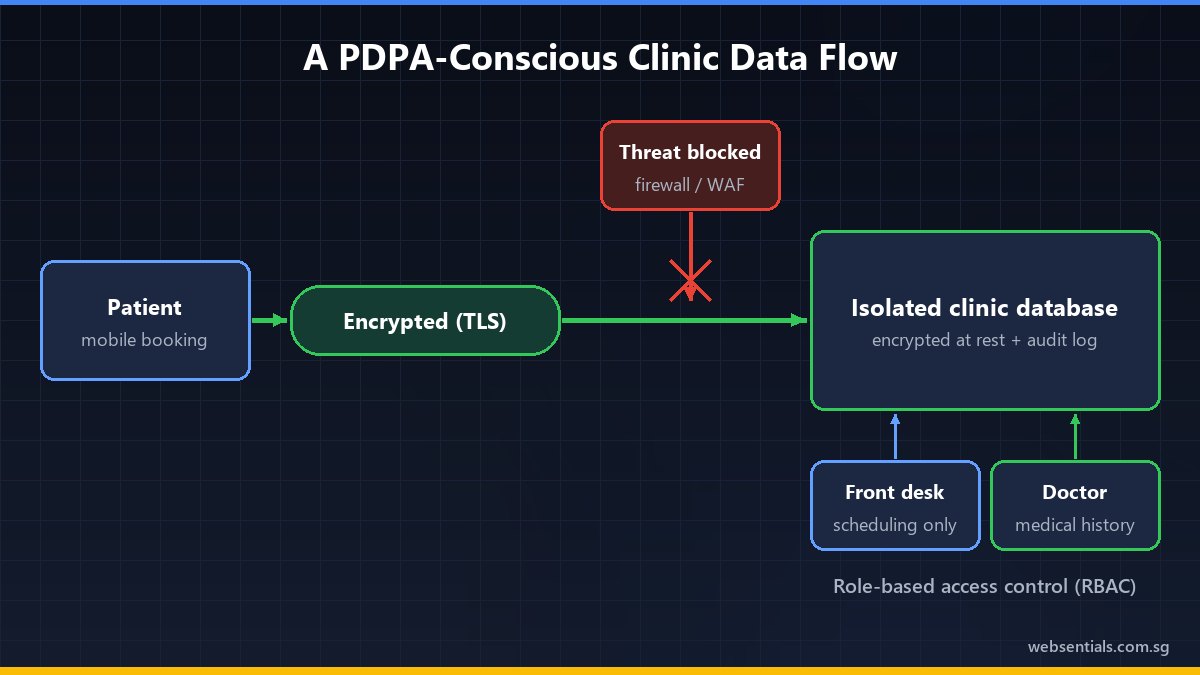
A professional clinic website needs a secure backend. Appointment requests and pre-consultation forms should be encrypted in transit (we recommend TLS 1.2 or higher) and at rest in the database. A responsive CMS website for a clinic should also use role-based access control, so a receptionist sees scheduling data while sensitive medical fields stay visible only to the treating doctor.
Audit logs that record which staff member accessed which record, and when, help you demonstrate accountability if the PDPC ever investigates. If you are reviewing your setup, our CMS cloud security checklist is a useful starting point.
2. MOH and HCSA Advertising Rules
Licensed healthcare providers in Singapore can only advertise in line with the Healthcare Services (Advertisement) Regulations 2021. MOH’s position is that healthcare advertising must be accurate and truthful and must not induce unnecessary use of healthcare services [2].
In practice, clinic websites generally must avoid laudatory claims such as being the “best” or “leading” clinic, and must not publish before-and-after (or after-only) treatment photos or patient testimonials. An experienced digital partner structures your content around these rules and builds authority through factual transparency instead: doctors’ registered qualifications, clear service and pricing information, and educational content that helps patients make informed decisions. This is general guidance, not legal advice; check MOH’s latest requirements for your licence type.
3. Fast Mobile Experience and Easy Appointment Booking
Patients searching for a clinic are often uncomfortable or anxious, and most of them search on their phones. If they have to pinch and zoom to read your services, or the booking page won’t load, they’ll go to the next clinic.
A well-built clinic site focuses on fast mobile loading: optimised images, efficient code, quality local web hosting and a sticky, thumb-friendly “Book Appointment” button that stays visible as patients scroll. The booking flow should ask for as little as possible, and returning patients should be able to book follow-ups in a couple of taps.
4. Demonstrating Medical Authority (E-E-A-T)
Google treats health content as “Your Money or Your Life” (YMYL), holding it to a higher standard because inaccurate information can harm people. Its guidance on creating helpful, reliable content emphasises experience, expertise, authoritativeness and trustworthiness (E-E-A-T).
A clinic website shows this through dedicated doctor profiles listing medical degrees, specialist accreditation and clinical experience, plus accurate, regularly reviewed health information. You can see the impact of this approach in the testimonial from Dr. Wong Weng Kin, Medical Director, and in our dedicated healthcare solutions.
5. Local Visibility and Qualified Patient Enquiries
Most patients look for a clinic near them, so ranking for local and “near me” searches directly affects appointment volume. Clinics also need enquiries from people looking for the specific treatment they offer, not generic traffic. That’s where local SEO, targeted search ads and a well-maintained Google Business Profile work together.
Real Singapore Examples
Websentials has worked directly with healthcare clinics in Singapore:
- 1728 Dental Practice: targeted Facebook and Google Ads campaigns boosted the practice’s digital presence and generated a substantial volume of qualified leads, increasing appointment bookings and visibility in a highly competitive local market.
- River Physio: our marketing strategy raised the clinic’s brand exposure in its target market and generated qualified leads that converted into measurable, revenue-contributing patient bookings.
- Dr. Wong Weng Kin, Medical Director: how a robust digital presence supports operational efficiency and patient trust.
How Websentials Supports Healthcare Clinics
Depending on your clinic’s specialty and current setup, we typically draw on:
- Web development: a professional, appointment-ready website that reflects the trust patients expect.
- Custom CMS development: secure, isolated systems for patient portals, scheduling and tele-consultation features.
- SEM / Google Ads: campaigns that reach people searching for your specific treatments. Learn more in Why You Need Professional Google Ads Management.
- SEO, including local SEO, so nearby patients find your clinic.
- Website maintenance: proactive updates and security monitoring to keep patient data safe.
Frequently Asked Questions
What makes a clinic website PDPA-compliant in Singapore?
A PDPA-compliant clinic website protects patient data at every touchpoint. That means secure, encrypted forms instead of plain email scripts, an encrypted database in a secure hosting environment, and role-based access so only authorised staff see sensitive details. The site should also have a clear privacy policy explaining why data is collected and how it is used.
Can my aesthetic clinic show before-and-after photos on its website?
Generally, no. Under MOH’s healthcare advertising rules, licensed clinics should not publish before-and-after (or after-only) treatment photos on public platforms such as websites and social media, even with disclaimers. Such images are typically reserved for private, one-to-one consultations with a patient. Check MOH’s current guidance for your specific licence.
Do I need a custom CMS for my clinic website?
A simple informational site can run on a standard platform. But if you plan a secure patient portal, integrated scheduling or tele-consultation, a custom corporate CMS gives you the data isolation and security architecture to keep your patient database separate from your public marketing website.
Getting Started
Every clinic has different specialties, patient volumes and growth goals, so we start with a consultation to understand your needs before recommending a scope. We can also audit your current site for security gaps and advertising compliance risks. Contact Websentials to discuss a secure website or patient acquisition plan for your healthcare clinic in Singapore.
References
- Personal Data Protection Commission: Advisory Guidelines for the Healthcare Sector (revised 2023)
- Ministry of Health: Regulation of Advertisements for Aesthetic Treatments
- Singapore Statutes Online: Healthcare Services (Advertisement) Regulations 2021