Digital Solutions Specialist Singapore

Maximizing ROI: Why You Need Professional Google Ads Management
August 11, 2026
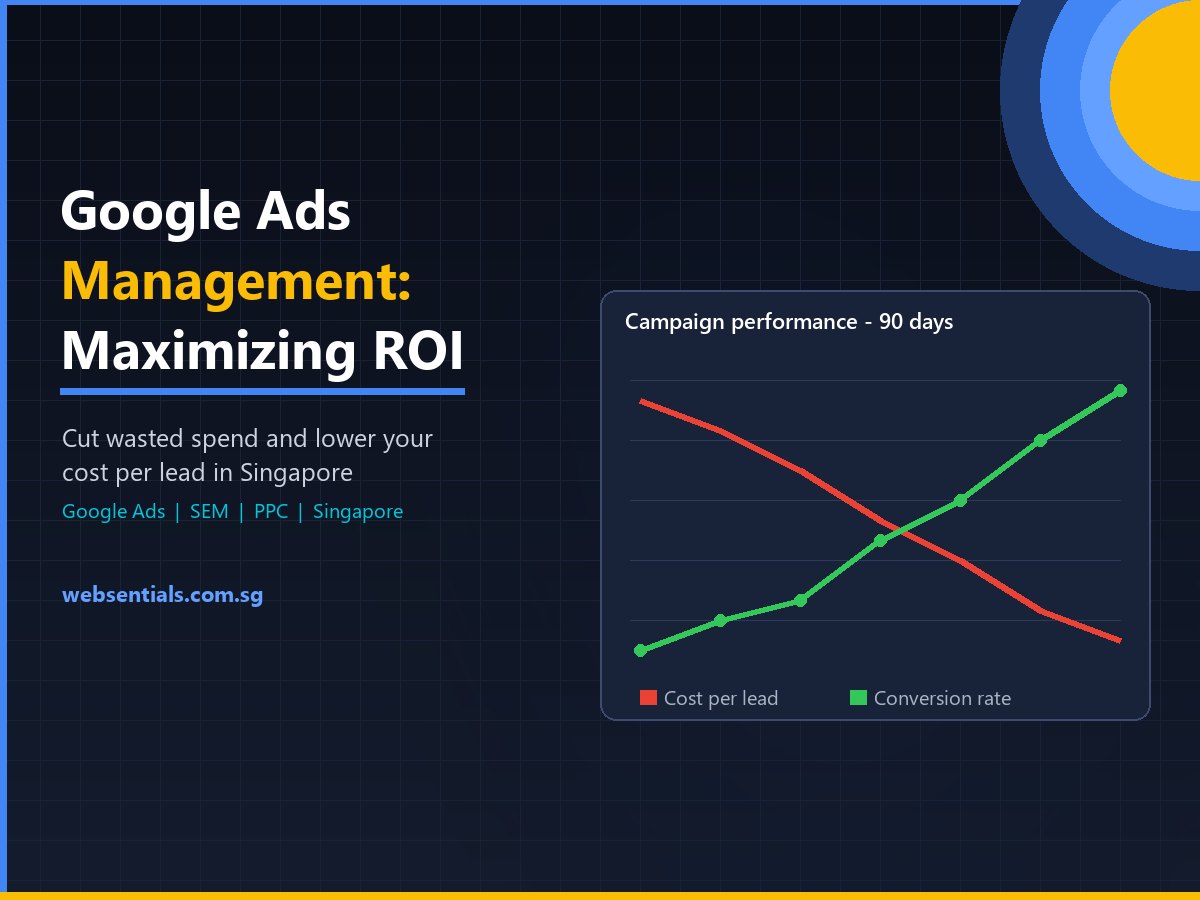
Professional Google Ads management in Singapore turns wasted ad spend into qualified leads through strategic bid automation, precise keyword targeting and constant optimisation. Here is why DIY campaigns so often leak budget, and what an experienced team does differently.
Why DIY Google Ads Campaigns Waste Budget
Google Ads is arguably the most powerful intent-based marketing platform there is. When someone in Singapore searches for a specific service, they are telling you exactly what they want to buy. But the platform is unforgiving to inexperienced advertisers.
Many businesses run Pay-Per-Click (PPC) campaigns in-house, assuming it is as simple as picking a few keywords and setting a daily budget. That approach almost guarantees wasted spend. WordStream’s 2026 benchmarks put the average cost per click (CPC) across industries at US$5.42 and the average cost per lead (CPL) at US$70.11 [1]. In competitive sectors such as legal services, business consulting or home improvement, a single click can cost US$8–10 or more.
When you pay premium prices per click, you can’t afford the wrong traffic. Without thorough negative keyword lists, tight match types and proper conversion tracking, businesses routinely spend thousands on clicks that never had a chance of converting. Industry data suggests advertisers who don’t regularly recalibrate budgets and targeting overspend by 15–25% per acquisition.
Working with a professional search engine marketing agency in Singapore shifts your strategy from “buying clicks” to building a predictable, high-ROI lead generation pipeline.
In-House “Set & Forget” vs. Professional Agency Management
| Campaign element | Typical in-house execution | Professional agency execution | Impact on ROI |
|---|---|---|---|
| Keyword match types | Heavy reliance on broad match, which captures irrelevant traffic | A deliberate mix of exact and phrase match | Less budget spent on irrelevant searches |
| Negative keywords | Rarely updated or missing | Updated weekly from live search terms reports | Ads stop showing for “free”, “cheap” or “jobs” searches |
| Bidding strategy | Manual CPC or basic “Maximise clicks” | Smart Bidding such as Target CPA or Target ROAS | Bids focus on users most likely to convert |
| Conversion tracking | Only clicks or page views | Real leads: form submissions, calls, sale values | Accurate ROI down to the cent |
| Ad copy testing | One generic ad for months | Continuous A/B testing of headlines and CTAs | Higher click-through rate (CTR) helps lower cost per click |
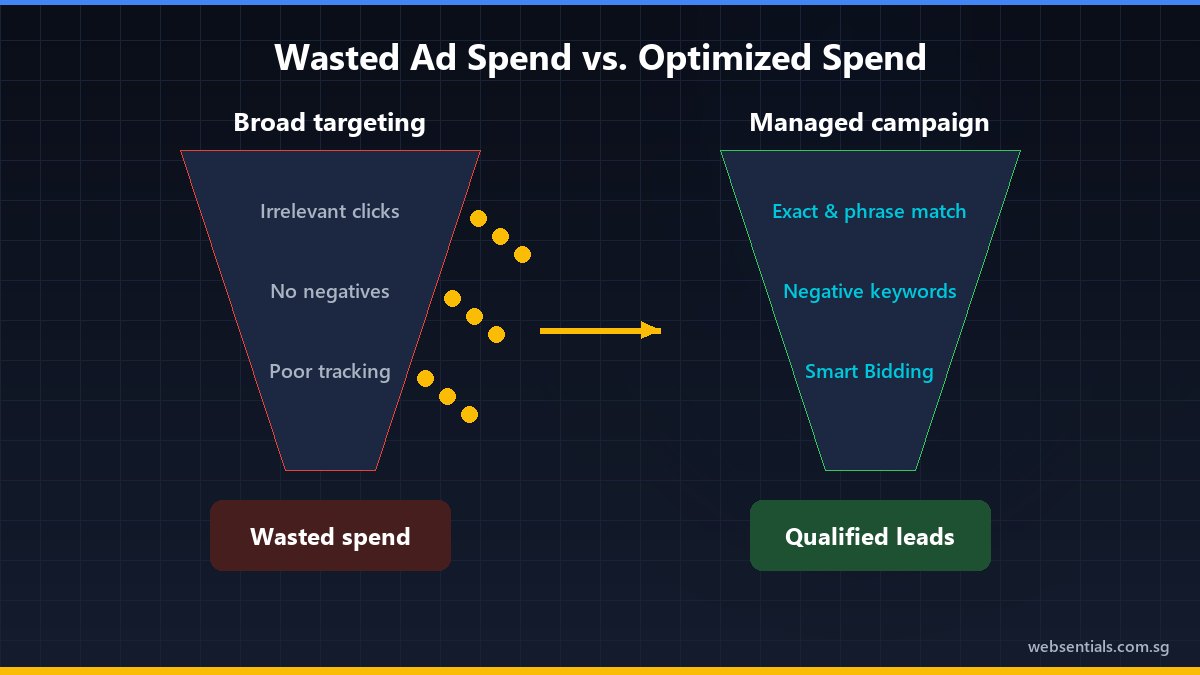
How Professional Google Ads Management Eliminates Wasted Spend
The difference between a profitable Google Ads campaign and a financial drain lies in the daily, careful adjustments a certified specialist makes. Here is how an experienced SEM agency protects and stretches your budget.
1. Stopping Budget Bleed with Negative Keywords and Match Types
Default Google Ads settings are designed to maximise reach, not your return. If you add a keyword like office cleaning services on broad match, Google may show your ad to someone searching for how to clean a home office desk. You pay for that click even though the searcher wants DIY advice, not a commercial cleaning contract.
Professional managers use tight phrase and exact keyword match types to control when your ads appear. Just as importantly, they maintain extensive negative keyword lists. By excluding terms like free, cheap, jobs, DIY or internship, an agency makes sure your budget only goes to high-intent, commercially viable searches. This single tactic often recovers a large share of wasted budget within the first month.
2. Using Smart Bidding and AI Automation
Bidding manually on hundreds of keywords is impossible to do well. Google’s machine learning weighs huge numbers of signals in milliseconds, including device, location, time of day and search context, before anyone even sees your ad.
Professional Google Ads management uses these algorithms through Smart Bidding strategies such as Target CPA (cost per acquisition) or Target ROAS (return on ad spend). But the AI is only as good as the data it receives. An agency structures your campaigns to feed the algorithm clean conversion data, so it bids hard when a high-value prospect is searching and pulls back when conversion is unlikely.
3. Granular ROI Tracking and Attribution
You can’t optimise what you don’t track. Many DIY advertisers see clicks on their dashboard but have no idea which keyword produced a phone call or a submitted contact form.
Before spending a dollar of your budget, a professional agency sets up conversion tracking through Google Tag Manager and Google Analytics 4 (GA4). Every lead or sale is attributed to the keyword, ad and time of day that produced it. Once you know which campaigns generate revenue and which only generate traffic, budget can move to the winners, steadily lowering your cost per lead.
4. Improving Quality Score to Lower Click Costs
Google rewards relevant ads with lower costs. This is reflected in Quality Score, which is based on expected click-through rate, ad relevance and landing page experience.
If your ad copy closely matches the search and your landing page is fast, mobile-friendly and relevant, you can pay less per click than a competitor with a poor Quality Score. That’s why agencies obsess over it. Continuous A/B testing of headlines and better landing pages stretch your budget further without spending an extra cent. If your landing page is the weak link, read Landing Page vs. Website Redesign: What Does Your Singapore Business Really Need?
Frequently Asked Questions
Why is my Google Ads campaign getting clicks but no leads or sales?
Clicks without conversions usually point to one of two problems: poor search intent targeting or a weak landing page. If you use broad match keywords without negatives, you are probably paying for irrelevant traffic. If the traffic is qualified but the landing page is slow, confusing or lacks a clear call to action (CTA), visitors leave straight away.
How long does it take to see a positive ROI from Google Ads?
Google Ads can drive traffic immediately, but a sustainable, positive ROI typically takes 4 to 12 weeks. The first month is a learning phase: the agency tests which keywords work, gathers data and aggressively prunes wasted spend with negative keywords. By months two and three, Smart Bidding has enough conversion data to optimise efficiently, lowering cost per lead and scaling profitability.
Is hiring a Google Ads agency really worth the management fee?
For most businesses, yes. A skilled agency typically saves more in wasted spend than it charges in fees. If a DIY campaign spends $5,000 a month at a $200 cost per lead, it generates 25 leads. If an agency brings that same budget down to $100 per lead, you get 50 leads. The revenue from those extra qualified leads usually far outweighs the management fee.
Stop Guessing and Start Scaling with Websentials
Running Google Ads without precise tracking, negative keyword management and bid automation is a fast way to exhaust your marketing budget. Every click you pay for should be a calculated step towards a sale.
At Websentials, our performance marketing team builds high-converting PPC campaigns for the Singapore market. We don’t chase clicks; we optimise for revenue. For a broader look at paid search, see our SEM agency guide to Google Ads in Singapore, and for organic growth alongside ads, read SEO vs AI Search Optimization (AEO).
- Request a free campaign audit: our specialists will review your Google Ads account and show you where budget is leaking.
- Explore strategic management: see how our SEM services in Singapore use data-driven bidding to lower your cost per lead.
- Improve your landing pages: pair your campaigns with high-converting pages from our website design company in Singapore to maximise ROI.
Stop letting Google decide how your budget is spent. Contact the Websentials team today to turn your ad spend into predictable revenue.
References
- WordStream (2026): Google Ads Benchmarks 2026: Competitive Data & Insights
- Google Ads Help: About keyword matching options
- Google Ads Help: About Quality Score for Search campaigns