Digital Solutions Specialist Singapore

SEO vs AI Search Optimization (AEO): What Singapore SMEs Need to Know in 2026
July 28, 2026
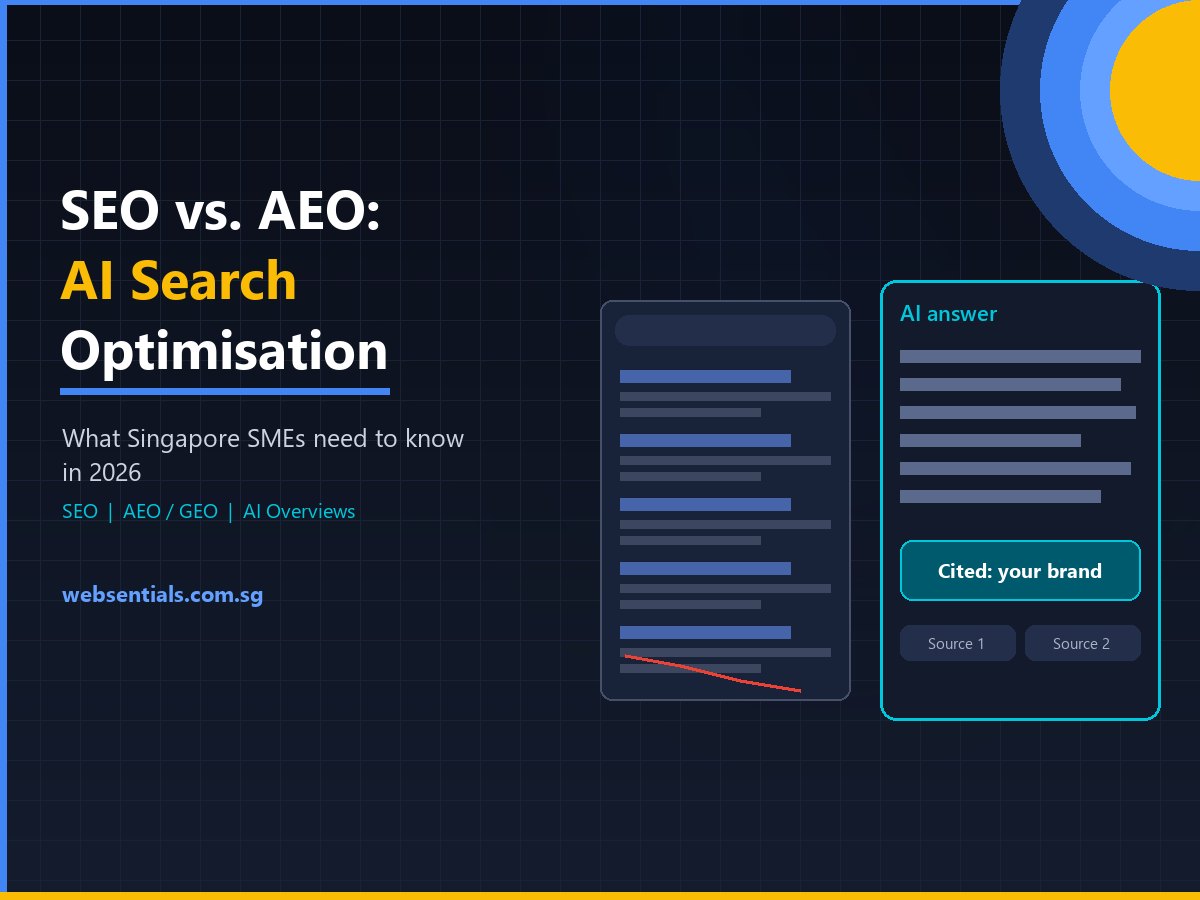
SEO earns you a ranking on a search results page; AEO (Answer Engine Optimisation) earns your brand a citation inside an AI-generated answer from tools like Google AI Overviews, ChatGPT and Perplexity. In 2026, Singapore SMEs need both, and AEO only works when it is built on a strong SEO foundation. Here is what changed, how the two differ and what to prioritise.
If you have started asking ChatGPT, Google’s AI Overviews or Perplexity for business recommendations instead of typing a search query, you are not alone, and neither are your customers. This shift has created a new discipline alongside traditional SEO: AI Search Optimisation, also called AEO (Answer Engine Optimisation) or GEO (Generative Engine Optimisation).
What Is AI Search Optimisation (AEO)?
AI Search Optimisation is the practice of improving how often, and how favourably, your business is mentioned or cited when someone asks an AI tool a question, rather than when they type a query into a traditional search engine. Instead of aiming for the #1 ranking on a results page, the goal is to be the source an AI assistant draws from and cites in its answer.
The mechanics differ from classic search. AI answer engines synthesise a response from many sources at once, including your website, business directories, review platforms, government or industry listings and social profiles, rather than sending users to click through ten blue links. Google explains how its own AI features select and link to sources in its guide to AI features and your website.
Why AEO Matters for Singapore SMEs in 2026
For two decades, digital visibility followed a simple pattern: a user typed a keyword, Google listed web pages, the user clicked and your site gained traffic. Generative AI engines have rewritten that pattern. They read the web on the user’s behalf, summarise what they find and often answer the question directly, with no click required.
Industry studies suggest the shift is significant. Around 60% of US Google searches now end without a click to any website, rising to roughly 77% on mobile, according to Similarweb data compiled in 2026 [2]. And 51% of B2B software buyers now start vendor research in an AI chatbot rather than Google, up from 29% in April 2025 [1]. Exact figures vary by study and market, but the direction is clear.
For Singapore SMEs, this is arriving fastest in commercial categories such as digital services, healthcare, F&B and professional services, where buyers increasingly ask an AI assistant to shortlist providers before visiting any website. When someone asks which Singapore accounting firm, aesthetic clinic or software vendor can solve their problem, your business is either in that answer or left out of the shortlist.
SEO vs. AEO: How They Differ
Traditional SEO and AEO share the same goal, being found by the right customer at the right moment, but they optimise for different outcomes.
| Dimension | Traditional SEO | Answer Engine Optimisation (AEO) | Business impact in 2026 |
|---|---|---|---|
| Primary goal | Get users to click through to your website | Earn a brand citation inside an AI-generated answer | Keeps your brand visible even in zero-click searches |
| Core success metric | Rankings, organic traffic and click-through rate | AI visibility, share of voice and citation placement | Reaches buyers early, before they visit any site |
| Content structure | Comprehensive pages built around target keywords | Answer-first paragraphs, structured data and FAQs | AI systems can extract clear, factual answers easily |
| Authority signals | Backlinks and domain authority | Consistent entity data and third-party mentions | AI engines cross-check reviews, forums and directories |
| User journey | Search → click → read → convert | Prompt → direct answer → follow-up prompt | Shortens research, so brands must prove value quickly |
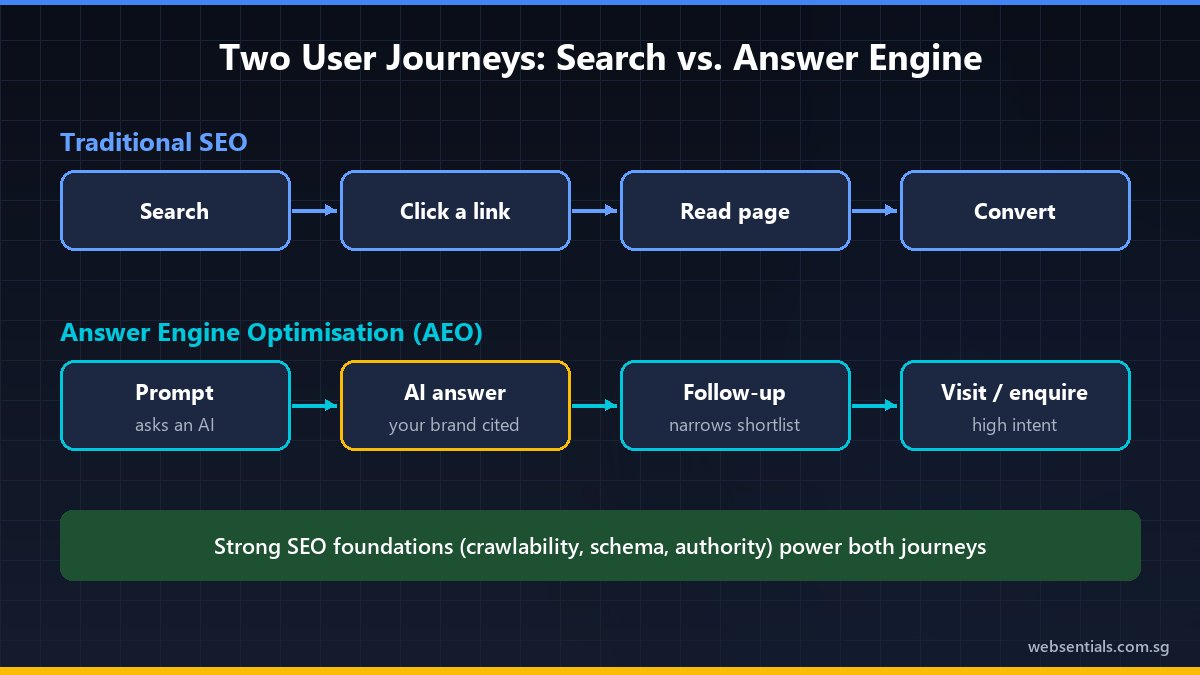
Crucially, AEO is not a replacement for SEO. It is a specialised layer built on top of it. An AI system still needs to discover, crawl and understand your website before it can decide whether to cite it, and those are fundamentally SEO tasks.
Does Your Existing SEO Work Also Help With AI Search?
Yes, substantially. AI answer engines draw on the same signals that good technical SEO already builds:
- Technical health and crawlability: an AI crawler needs to access and parse your site, just like a traditional search bot.
- Structured data / schema markup: clearly labelled Organization, Service and FAQ schema gives AI models an unambiguous, machine-readable summary of what your business does.
- Clear content hierarchy: well-structured headings and direct-answer paragraphs are exactly the format AI models extract most easily.
- Authoritative citations: the off-site signals that build SEO authority (directories, reviews, press, government or industry listings) are also what AI models use to corroborate a brand.
A business with weak technical SEO and thin content starts AEO at a serious disadvantage; there is no shortcut around the fundamentals. See our SEO agency services in Singapore for how we build this foundation, or start with a free SEO audit.
4 Strategies to Get Your Brand Cited by AI
Large Language Models (LLMs) don’t process information the way traditional search bots do. They map entities, relationships and third-party consensus to judge who is authoritative on a topic. Once your SEO foundation is solid, these strategies make the biggest difference.
1. Build Third-Party Consensus (Earned Media)
The biggest difference between SEO and AEO is where authority comes from. Your own blog still matters, but generative engines lean heavily on what independent sources say about you. Muck Rack research found that 82% of AI citations come from earned media rather than owned content or paid placements [2].
When an AI tool answers “best corporate secretarial services in Singapore”, it draws on review sites, industry forums, digital PR articles and trusted directories. To earn citations, build authority beyond your own domain: invest in digital PR, encourage genuine customer reviews on platforms such as Google Business Profile, and make sure your brand is discussed in relevant industry communities.
2. Use “Answer-First” Content Structure
AI systems favour content where the answer is easy to find and extract. If the answer to a question is buried under five paragraphs of introduction, the AI is more likely to quote a competitor whose page gets to the point.
Modern search engine optimisation therefore uses an answer-first structure. Rework your core service pages and blog posts to answer the specific questions your buyers ask:
- Use H2 and H3 headings phrased as the exact questions your buyers ask.
- Directly under each heading, give a concise, factual answer in under 50 words.
- Support the answer with lists, data tables and specific figures.
- Add JSON-LD schema markup, such as FAQPage, LocalBusiness and Organization, so AI systems can read your entity data directly.
3. Keep Local Entity Data Consistent
For physical businesses and local service providers in Singapore, geographic precision matters. AI assistants increasingly tailor answers by location, drawing on pages that clearly state where you are, what you offer and when.
If you operate from several locations, for example clinics in Novena and Tampines, create a distinct local page for each one with consistent name, address and phone (NAP) details. Inconsistent data across directories fragments your brand entity, making AI models less confident about recommending you.
4. Move from Keywords to Topic Clusters
Generative engines look for topical depth, not keyword-dense pages. A brand with one long page about “HR software” is less visible to AI than a brand with ten interlinked pages covering compliance, payroll integration, leave management and onboarding.
AI systems often break a complex prompt into smaller sub-questions and look for the best source for each. Comprehensive topic clusters make your site the go-to source across those sub-questions, increasing the chance of being cited.
How to Prepare Your Business for AI Search Optimisation
For most Singapore SMEs, the practical starting point is the same whether you call it SEO or AEO preparation:
- Get your technical SEO foundation right: crawlability, site speed, mobile usability and clean indexation. (Server speed matters too; see The Hidden Link Between Web Hosting and Your SEO Rankings.)
- Implement accurate structured data: Organization, Service and FAQ schema at minimum.
- Rewrite key pages to open with a clear, direct answer to the question your customer is actually asking.
- Check and correct your presence on relevant directories, review platforms and any government or industry listings you are eligible for.
- Only then layer on AEO-specific tracking and refinement. Skipping straight to “AI optimisation” without the SEO foundation rarely works.
Frequently Asked Questions
What is the practical difference between SEO and AEO/GEO?
SEO aims to rank your web pages on a search engine results page to drive traffic to your site. AEO, also called GEO, optimises your brand’s wider digital footprint so that AI tools such as ChatGPT, Perplexity and Google’s AI Overviews cite your business directly in their answers. AEO builds on SEO rather than replacing it.
Will AI search kill my website traffic?
AI Overviews and zero-click searches have reduced informational, top-of-funnel traffic, but high-intent traffic remains strong. People ready to buy, book a consultation or browse a detailed catalogue still click through to websites. The aim of AEO is to make sure your brand is the one the AI recommends during the research stage.
How do I measure the ROI of Answer Engine Optimisation?
Because zero-click answers send little referral traffic, AEO needs different metrics from website sessions. Track AI share of voice and citation visibility by regularly running key industry prompts across ChatGPT, Gemini and Perplexity and recording how often your brand is mentioned compared with competitors. Specialised tools can automate this tracking.
Future-Proof Your Brand with Websentials
The gap between businesses preparing for AI search and those relying only on traditional SEO is widening. Early movers are earning the citations that AI engines will keep referencing.
At Websentials, we combine technical search architecture with AI-driven business solutions so your brand stands out in both traditional search results and AI-generated answers. It is exactly why we treat SEO as the necessary first step rather than an older, separate discipline.
- Audit your AI visibility: our team will run diagnostic prompts across the major AI tools to see whether your brand appears in their answers.
- Restructure your content: upgrade key pages with schema markup and answer-first formatting.
- Combine AEO with SEO: work with our SEO specialists in Singapore on a strategy covering AEO, local search and traditional SEO.
If your business is ready to build that foundation, or you are already strong in SEO and want to see what AI Search Optimisation adds, contact the Websentials team today to discuss where your website stands.
References
- Omnibound (2026): Answer Engine Optimization (AEO) Statistics
- Omnibound (2026): Generative Engine Optimization Statistics
- HubSpot: Answer Engine Optimization Trends in 2026
- Google Search Central: AI Features and Your Website
- Erlin AI: Generative Engine Optimization Trends for 2026