Digital Solutions Specialist Singapore

Building a Digital Mall: The Ultimate Guide to Multi-Vendor E-Commerce Websites
July 6, 2026
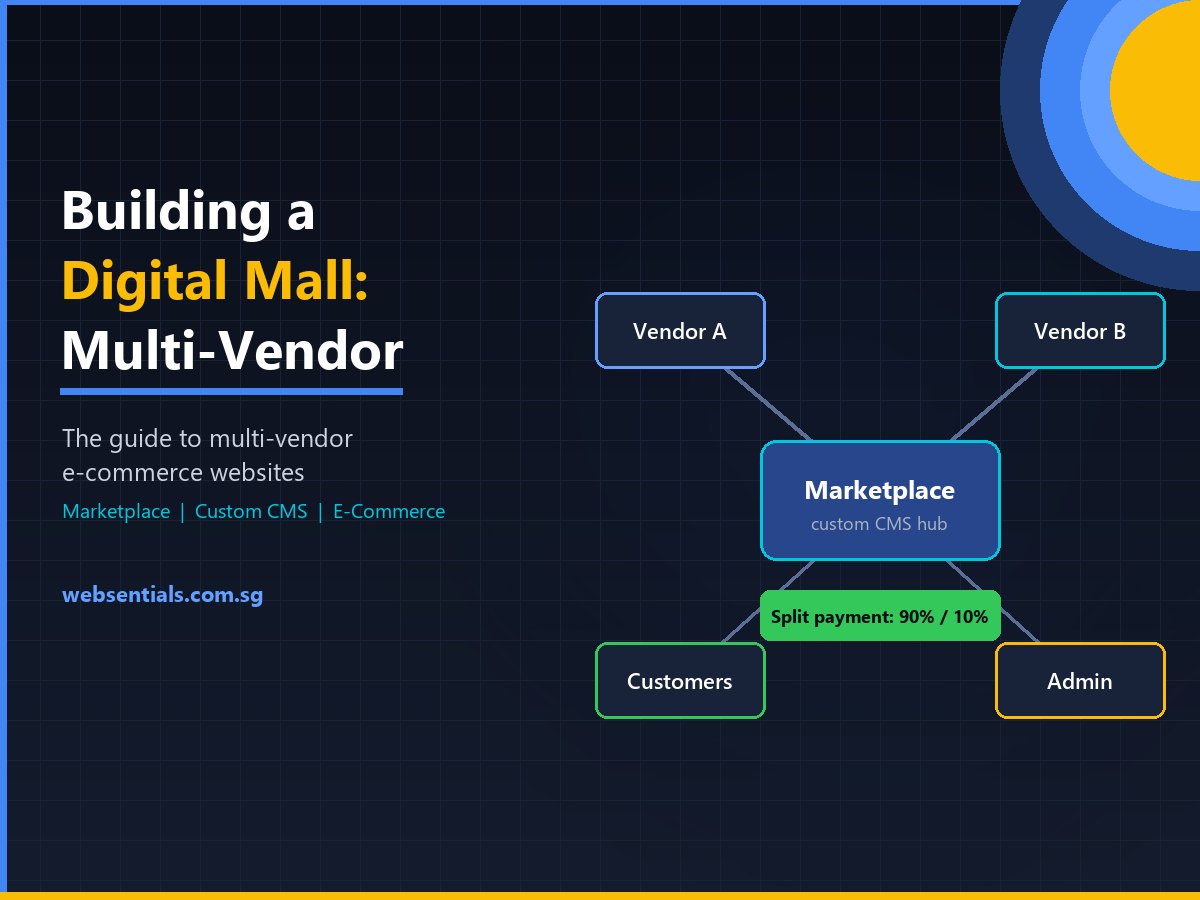
A multi-vendor e-commerce website, or digital mall, lets many independent sellers list and sell products to buyers on one platform. Building one is a very different engineering challenge from a standard online store: it needs separate vendor portals, automated split payments, vendor-specific shipping and an architecture that stays fast under heavy traffic. This guide explains what that infrastructure involves and how to plan it.
Why Multi-Vendor Marketplaces Outgrow Standard E-Commerce Platforms
A standard e-commerce store manages one inventory, one payment flow and one fulfilment process. A digital mall, where hundreds of independent sellers interact with thousands of buyers at the same time, is an entirely different system.
When businesses scale from a single-vendor model to multi-vendor e-commerce websites, operational complexity multiplies. You’re no longer just selling products; you’re running a multi-tenant digital ecosystem. Off-the-shelf platforms stretched with add-ons start to struggle: vendor data gets mixed, split payments fail, inventory sync delays cause overselling, and slow database queries drag down page loads.
A marketplace is only as strong as its architecture. A fragile backend creates a poor vendor experience, which limits product range and, in turn, customer retention. Solving this means moving beyond basic plugins to properly structured databases, API-driven payment flows and automated vendor workflows.
Single-Vendor Store vs. Multi-Vendor Marketplace Infrastructure
| System requirement | Standard e-commerce store | Multi-vendor marketplace | Business impact |
|---|---|---|---|
| Inventory architecture | One central catalogue | Vendor-separated, multi-tenant data | Prevents data mixing and gives vendors control of their own listings |
| Payment routing | Payment goes to the store owner | Automated split payments (commission vs vendor payout) | Removes manual reconciliation and payout errors |
| Shipping | One set of shipping rules | Vendor-specific rates, couriers and zones | Lets vendors fulfil independently from different locations |
| Admin access | One master dashboard | Role-based access control (RBAC) per vendor | Protects platform integrity while giving vendors autonomy |
| Performance | Standard database setup | Caching, optimised queries and scalable hosting | Keeps pages fast during sales and traffic spikes |
Core Infrastructure for a Scalable Marketplace
Building a platform in the mould of Shopee or Lazada, even at a smaller scale, needs specialised engineering. These are the foundations.
1. A Custom CMS Built for Marketplaces
The content management system is the backbone of the marketplace. Standard platforms often struggle with the data relationships needed to link one customer order to several independent vendors.
Investing in custom CMS development in Singapore lets platform owners build an admin hub around their own operating rules: automated commission tiers, listing moderation and platform-wide financial reporting, without depending on a stack of fragile third-party plugins. Separating the frontend from the backend (a headless approach) also helps the platform stay stable as traffic grows.
2. Self-Service Vendor Portals
In a digital mall, vendors are your most important users. If it’s hard to upload products, track orders or withdraw earnings, they’ll move to another platform. A capable e-commerce website design company builds vendor dashboards that work independently of the main admin panel, including:
- Bulk product uploads: CSV imports or API sync for large catalogues.
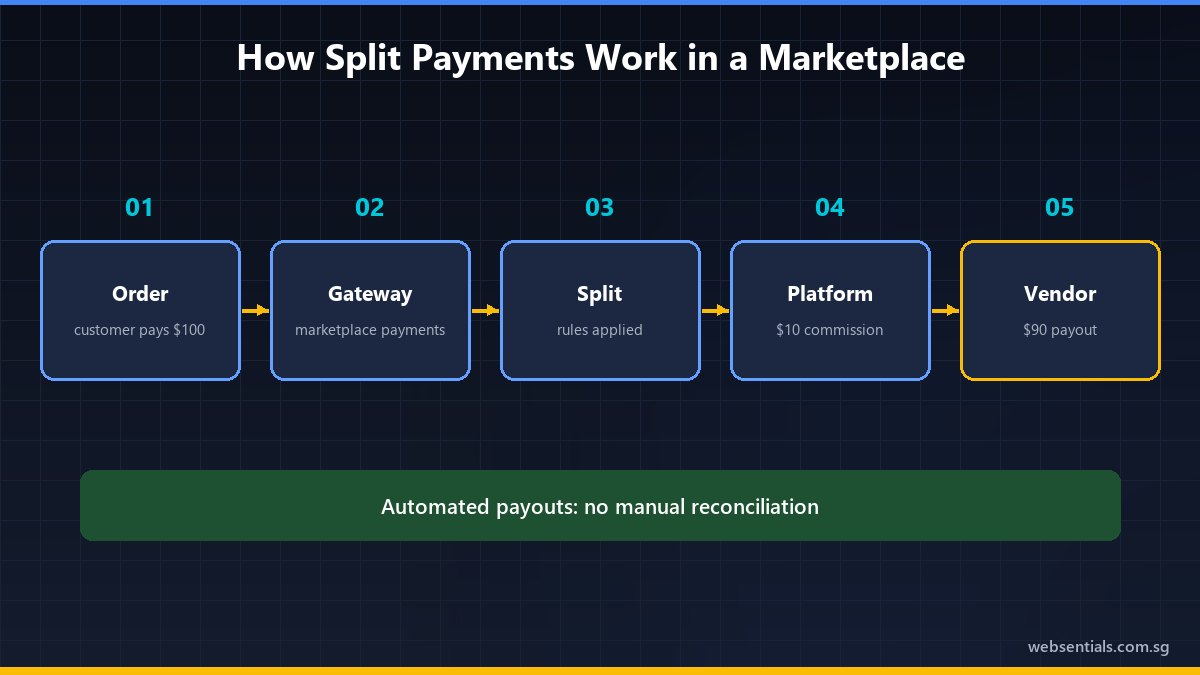
- Automated split payments: marketplace payment tools such as Stripe Connect can separate the platform’s commission from the vendor’s share at the point of sale [1].
- Vendor-specific logistics: each seller sets their own shipping rules, couriers and regional restrictions without overriding platform settings.
3. Hosting and Maintenance That Can Handle the Load
Marketplaces generate heavy database traffic: every search checks stock, prices and shipping across many vendors. Basic shared hosting can buckle under that load. A marketplace needs scalable cloud hosting, caching and optimised queries, plus ongoing website maintenance to keep payment integrations updated, apply security patches and prevent the database from slowing down before peak sales. Our guide to choosing the right web hosting in Singapore covers the options.
4. SEO Architecture for Thousands of Products
Marketplaces depend on organic search to bring buyers to niche vendor products, but SEO at that scale is complex: duplicate listings, near-identical pages and messy URLs are common problems. A marketplace-ready SEO strategy builds the rules into the CMS: automatic canonical tags, product structured data for prices and reviews, and clean category-based URLs, so search engines can crawl and index new listings efficiently.
Frequently Asked Questions
Why shouldn’t I build a marketplace with standard e-commerce plugins?
Standard e-commerce plugins are designed for a single seller. Stretched into a marketplace with add-ons, they can become slow, hard to secure and prone to data-separation problems between vendors. For a serious marketplace, purpose-built multi-vendor architecture is safer and scales better.
How do split payments work on a multi-vendor platform?
Marketplace payment tools process the customer’s payment and automatically divide it according to rules you set. For example, on a $100 order with a 10% commission, $10 goes to the platform and $90 to the vendor. This automates payouts and reconciliation; check with your payment provider and advisers about the regulatory obligations that apply to your model.
How long does it take to build a multi-vendor marketplace?
It depends on the number of features, integrations and vendor workflows. A focused first version with core vendor, payment and shipping features can launch sooner, with advanced features added in phases.
Build Your Digital Mall with Websentials
Moving from a traditional store to a marketplace requires technical foresight, secure data design and a smooth vendor experience. At Websentials, we design and build scalable e-commerce platforms, custom CMS architecture and high-performance frontends for Singapore businesses.
- Consult on system architecture: map your vendor workflows, commission structures and data needs with our engineers.
- Review our work: see platforms we’ve built in our project showcase.
- Explore custom infrastructure: learn more about our custom CMS development services.
Ready to plan your digital mall? Contact the Websentials team today to schedule a technical consultation.
References
- Stripe Documentation: Connect charge types for platforms and marketplaces
- Google Search Central: Product structured data