Digital Solutions Specialist Singapore

Headless vs. Open-Source: Choosing the Right CMS Website Design for Enterprise
August 15, 2026
Choosing between a headless CMS and a traditional open-source CMS is one of the biggest decisions in enterprise CMS website design. Your content management system (CMS) strategy has to balance speed, security and scalability, and in 2025 over 74% of digital decision-makers said they planned to move from traditional platforms such as WordPress towards headless architectures [1].
This guide breaks down the core differences between monolithic (traditional) and headless CMS architectures to help you decide which is the right investment for your business.
Why Traditional Monolithic CMS Platforms Struggle at Enterprise Scale
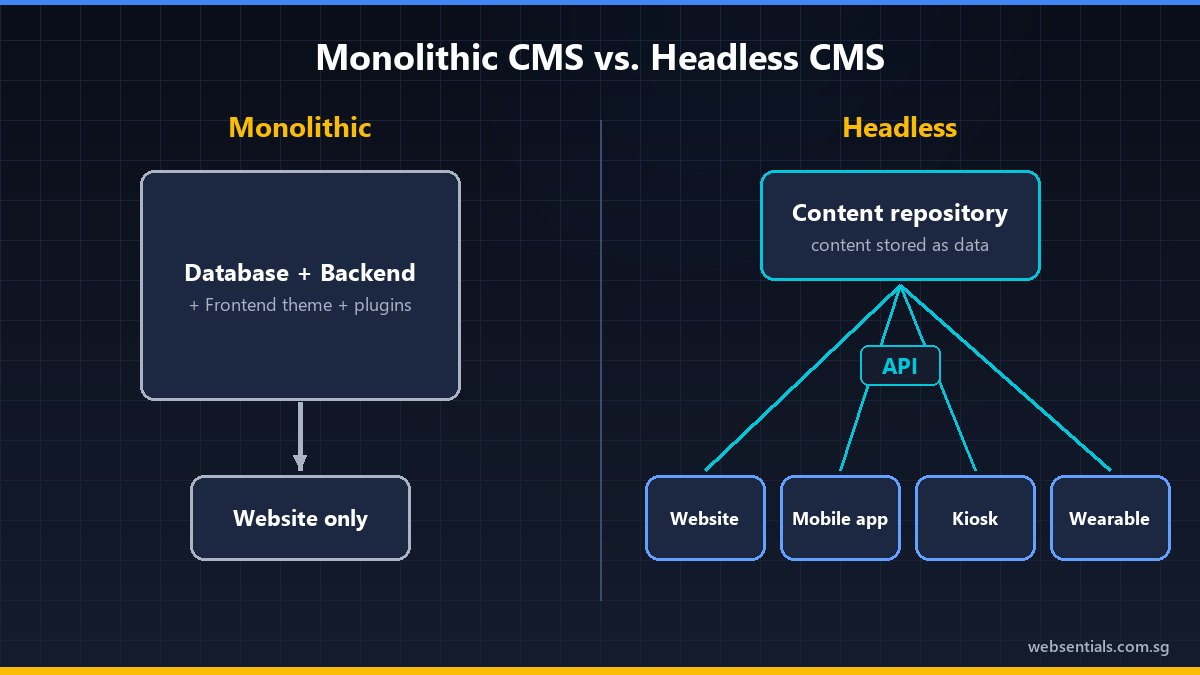
For decades, traditional monolithic platforms such as WordPress, Drupal and Joomla dominated the web. They offered a simple all-in-one solution: the database, the backend code and the frontend presentation layer (themes and templates) were tightly woven together.
But customer behaviour has changed. People no longer interact with brands only on desktop websites; they use mobile apps, smartwatches, connected devices and digital kiosks. A traditional CMS struggles here because its content is tied to a web page template.
Monolithic systems also suffer from “plugin bloat”. To add enterprise functionality to a platform like WordPress, businesses install dozens of third-party plugins. That creates technical debt, slows database queries and widens the attack surface. Security researchers consistently find that the vast majority of WordPress vulnerabilities come from plugins and themes rather than the WordPress core.
For many enterprises, the answer to scalability is a headless CMS.
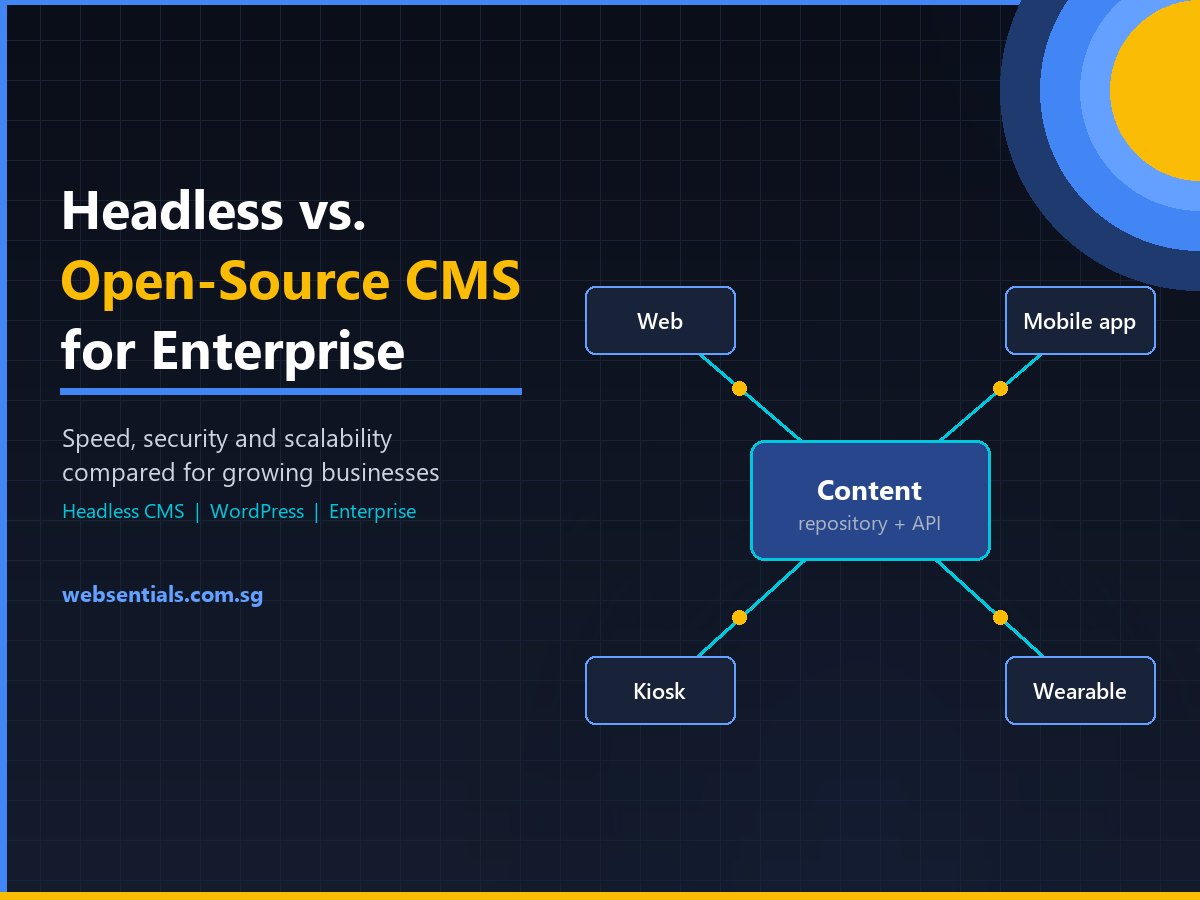
A headless architecture “decouples” the frontend presentation layer from the backend content repository. Content is created and stored as pure data in the backend, then delivered through APIs (Application Programming Interfaces) to any frontend or device.
Monolithic CMS vs. Headless CMS Architecture
| Feature | Traditional monolithic CMS (e.g. WordPress) | Headless CMS (e.g. Contentful, Strapi) | Enterprise business impact |
|---|---|---|---|
| Architecture | Coupled: frontend, backend and database are one system | Decoupled: content is delivered via API | A backend problem is less likely to take down the user-facing site |
| Content delivery | Single channel: content is locked into web templates | Omnichannel: web, mobile apps, kiosks and devices | One content strategy across every digital touchpoint |
| Security exposure | Higher: relies on third-party plugins and exposes the backend | Lower: the backend is hidden behind an API | A smaller attack surface for automated bot attacks |
| Performance | Pages are often built on the server for each request | Often pre-built (static generation) and served from a global CDN | Page load times frequently improve by around 30–50%, helping Core Web Vitals |
| Developer flexibility | Tied to the CMS’s own stack (e.g. PHP themes) | Any modern framework (React, Next.js, Vue) | Faster releases and modern UI/UX engineering |
Why Enterprises Are Choosing Headless CMS Solutions
For global brands and fast-growing SMEs, moving to a headless architecture is a strategic operational shift. Here is why enterprise IT and marketing teams are making the switch.
1. Omnichannel Scalability
On a standard WordPress site, the content you write, such as a product description, is formatted for that website’s theme. Launch a mobile app later and you have to recreate and reformat the same content for the app.
A headless setup built on enterprise CMS solutions in Singapore stores content as raw, structured data. When the marketing team publishes a campaign, the CMS sends that data through an API: the website takes what it needs, the mobile app takes what it needs and the in-store kiosk takes what it needs, all from a single source of truth. No duplicate data entry, and consistent branding everywhere.
2. Stronger Security and a Smaller Attack Surface
Traditional platforms are prime targets for cyberattacks. Because the login portal, database and frontend sit in the same system, an attacker who exploits a weak plugin can potentially reach the backend.
In a headless architecture, the frontend and backend don’t run in the same environment; the frontend only receives data through a secured API. Many headless sites also use static site generation (SSG), in which the site served to visitors is a set of pre-built files distributed across a Content Delivery Network (CDN). With no live database connected to the visitor’s browser, common attacks such as SQL injection have far less to target [4]. If you are staying on a traditional CMS for now, our CMS cloud security checklist for Singapore enterprises covers the essentials.
3. Faster Page Load Speeds
Enterprise e-commerce and SaaS companies live and die by conversion rates, and a widely cited benchmark suggests that a one-second delay in page load can cut conversions by around 7%.
Monolithic systems often rely on heavy server-side processing, building each page as it is requested. By decoupling the frontend, headless CMS website design lets developers use fast modern JavaScript frameworks such as React or Next.js, following the Jamstack approach. Because pages can be pre-built and cached on global CDNs, load times frequently drop by 30–50%, improving both user experience and technical SEO. (Hosting matters too; see The Hidden Link Between Web Hosting and Your SEO Rankings.)
4. Future-Proofing and Developer Freedom
Technology moves fast. With a traditional CMS, a full frontend redesign often means rebuilding much of the backend as well.
With custom CMS development, a headless system protects your investment. If a better frontend technology emerges in three years, your team can replace the user interface without touching the backend content repository. That modularity avoids costly “rip-and-replace” platform migrations.
Frequently Asked Questions
Is a headless CMS right for every business?
No. Headless architectures need specialised frontend development. For a small local business, a blogger or a company without in-house technical support, a traditional open-source CMS like WordPress remains the most cost-effective choice. Headless is designed for mid-market and enterprise companies that need high security, multi-channel content delivery and very fast load times.
How does a headless CMS affect the marketing team’s workflow?
Early headless systems felt too technical for marketers used to drag-and-drop builders. Modern enterprise platforms such as Contentful, Storyblok and Strapi now offer visual editing, so marketers can create, preview and publish content intuitively while the API handles distribution to each device.
What is the ROI of migrating to a headless CMS?
The return comes from lower maintenance overhead, better conversion rates and faster time-to-market. Companies using headless architectures report up to a 40% improvement in development efficiency [5]. And because headless sites load faster and score better on Core Web Vitals, businesses often see more organic search traffic and lower bounce rates.
Architect Your Digital Future with Websentials
Moving to a headless architecture isn’t just a website redesign; it is an upgrade to your entire digital infrastructure. If your current monolithic CMS is slowing your growth, exposing you to security risks or limiting your multi-channel marketing, it may be time to decouple.
At Websentials, we engineer high-performance digital ecosystems. Whether you need an API-first headless build for a complex web application or a highly customised hybrid CMS, our developers build the secure, scalable foundations enterprise brands need. For the bigger picture, read The Complete Digital Ecosystem Guide for SMEs.
- Request a technical architecture audit: our engineers will assess your current CMS and tell you whether a headless migration makes sense for your business.
- Explore enterprise capabilities: see how our corporate CMS development in Singapore creates secure, multi-tenant digital hubs.
- Secure your existing platform: not ready for a full migration? Protect your current CMS with our proactive website maintenance in Singapore packages.
Stop letting legacy technology dictate your digital speed. Contact the Websentials team today to discuss your enterprise CMS strategy.
References
- Business Research Insights (2025): Headless CMS Software Market Size, Growth, Report 2035
- Techxot (2025): Monolithic vs Headless CMS: The Shift Explained
- Jahia (2026): Headless vs. Traditional CMS: Which Is Best for Your Brand?
- Storyblok (2025): Headless vs. Monolithic CMS: Which Offers Better Security?
- VezaDigital (2026): Headless CMS vs Traditional CMS: Complete Comparison Guide