Digital Solutions Specialist Singapore

How AI is Revolutionizing Web Design Agencies in Singapore
August 5, 2026
An AI web design agency in Singapore no longer just builds pages from templates. It uses intelligent workflows, rapid prototyping and AI-assisted code generation to deliver enterprise-grade websites far faster than the traditional agency model. Here is what has changed, and what it means for your next website project.
Why the Traditional Web Design Workflow No Longer Works
For decades, the web design industry ran on a rigid, linear timeline. A client explained their vision, a designer spent weeks drafting wireframes, revisions bounced back and forth, and a developer then spent months writing the code. This waterfall approach is fragile: it is prone to miscommunication, budget overruns and painfully slow time-to-market.
Today, businesses cannot afford to wait six months to launch a digital storefront. If a competitor reaches the market faster with a better user experience, that market share is hard to win back.
Bringing Artificial Intelligence into the web design pipeline has broken this old model. By 2026, an estimated 84% of development teams use AI in some form within their workflows [1]. But there is a stark difference between agencies that simply use ChatGPT to write blog posts and those that have built AI into their core delivery process. Modern AI website development uses machine learning for rapid layout generation, automated accessibility checks and faster code production, so agencies can deliver customised, conversion-optimised platforms in a fraction of the historical time.
Traditional Agency Workflow vs. AI-Enhanced Workflow
| Process phase | Traditional linear workflow | AI-enhanced workflow | Business impact for the client |
|---|---|---|---|
| Ideation & mockups | 2–4 weeks of manual wireframing | Instant generation with AI Visualiser tools | Clients see their vision on day one, avoiding costly misunderstandings |
| Asset creation | Generic stock photos or expensive shoots | AI-generated, brand-specific imagery | Lower production costs and a more distinctive look |
| Code generation | 100% manual coding | AI-assisted UI code, reviewed by developers | Shorter development time and faster market entry |
| UX & accessibility | Manual audit after launch | Real-time AI accessibility scanning | Issues such as colour contrast and hierarchy are fixed during the build, not after |
| Optimisation | Static A/B testing | Dynamic, real-time personalisation | Layouts adapt to user behaviour, lifting conversion rates |
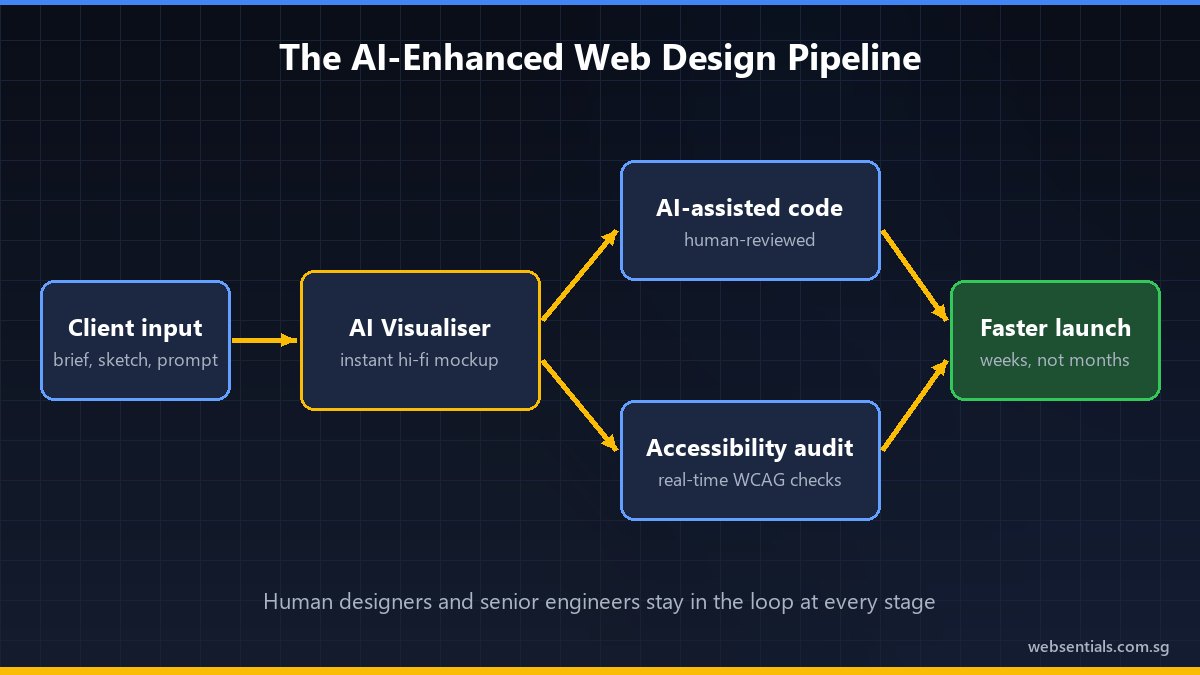
How AI Enhances the Web Design Process
The real value of AI in web design is not replacing the human designer. It is removing the operational friction that slows designers down. When a web design agency in Singapore adopts a “human-in-the-loop” AI methodology, the focus shifts from manual labour to strategic execution.
Rapid Prototyping with the AI Visualiser
The most frustrating phase of any web project is the gap between a client’s imagination and the first deliverables. Clients often struggle to put their visual preferences into words, which leads to endless revision cycles.
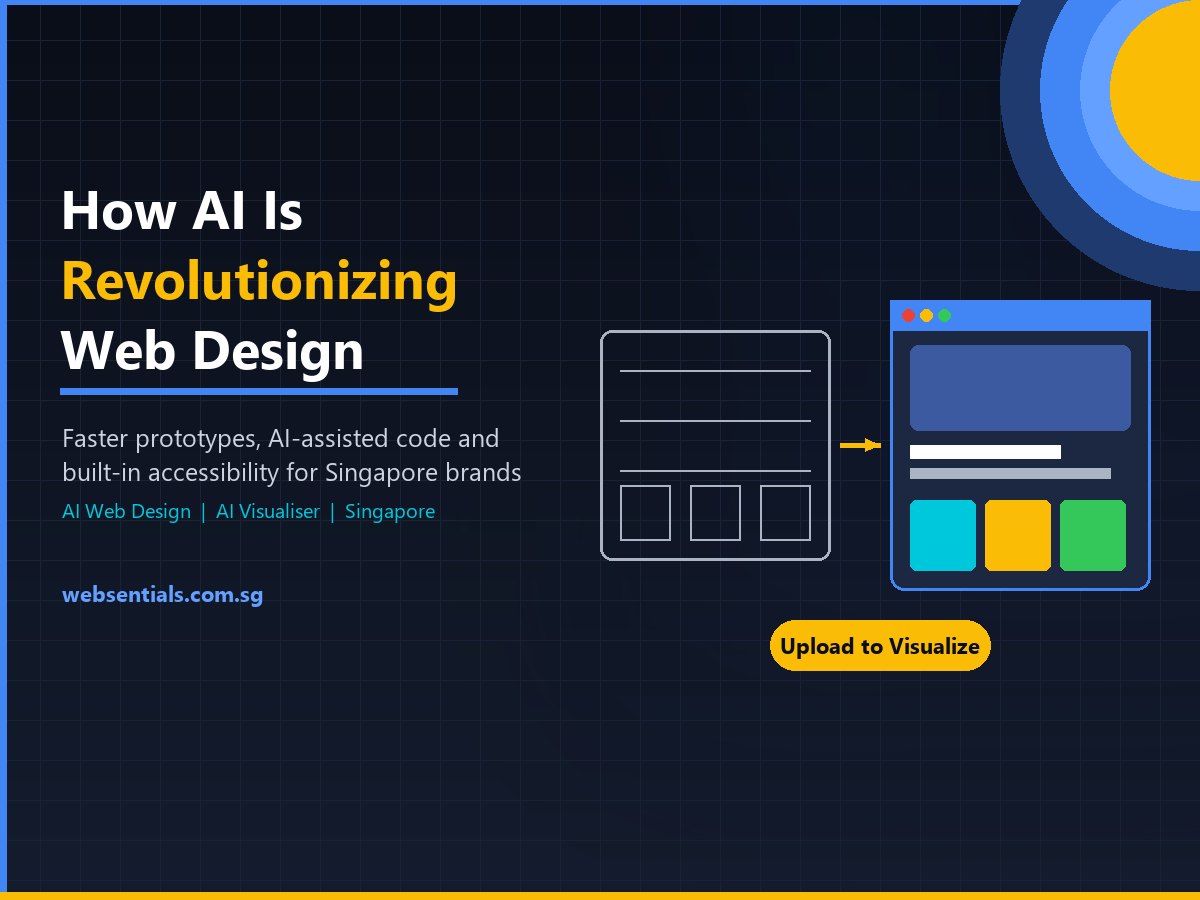
We built our proprietary AI Visualiser tool to close exactly this gap. Instead of waiting weeks for a static wireframe, clients use an “Upload to Visualize” workflow: enter basic parameters, upload a rough sketch or type a text prompt, and the Visualiser generates a high-fidelity digital mockup. The client and the design team can then agree on layout, colour hierarchy and structural flow immediately. Industry data suggests designers using AI for mockups can iterate up to two times faster [3]. (You can read more about how the Visualiser fits alongside our other tools in Beyond Chatbots: How AI Tools Like Sales Pathfinder and Visualiser Are Changing Singapore Business.)
AI-Assisted Code Generation and Deployment
Visual design matters, but the underlying code determines how the site performs. Writing the foundational HTML, CSS and JavaScript for a responsive website takes a lot of time.
Modern development teams use IDE-integrated AI assistants such as GitHub Copilot or Claude to speed this up. These tools are good at generating boilerplate code, tuning CSS for mobile breakpoints and catching syntax errors as you type. Some 2026 developer studies suggest AI-assisted developers are roughly 20% faster overall [2]. That frees developers to focus on harder architectural work, such as secure database design and API integrations, instead of typing repetitive styling code.
Dynamic Personalisation and Machine Experience (MX)
A traditional website is static: every visitor sees the same layout, whatever their intent. AI makes Machine Experience (MX) optimisation possible.
Advanced AI integrations can adjust a website’s content, calls-to-action (CTAs) and even navigation paths based on real-time user signals. If a returning visitor previously browsed enterprise software solutions, the site can reorder the homepage to feature enterprise case studies first. This kind of personalisation used to require enterprise budgets; AI has made it realistic for SMEs too.
Automated Quality Assurance and Accessibility
Making a website accessible to every user, including people with visual or motor impairments, is no longer optional. Traditional accessibility audits happened after the site was built, often forcing significant rework to fix colour contrast or missing ARIA labels.
AI tools can now scan the design and the code during the build itself. They flag contrast errors, suggest clearer navigation structures and check that the content hierarchy reads correctly for screen readers, measured against standards such as the W3C Web Content Accessibility Guidelines (WCAG). The result is a site that is inclusive and compliant from day one.
Speed matters after launch too. A fast design is only as fast as the server behind it; see The Hidden Link Between Web Hosting and Your SEO Rankings for how hosting affects performance.
Frequently Asked Questions
Does using AI mean my website will look like everyone else’s?
No. Basic templates create generic websites, but professional agencies use AI to speed up the process, not to replace creativity. Tools like our AI Visualiser help us brainstorm and structure the foundation quickly. The final look, brand voice and user experience are still crafted by human designers, so your site stays unique to your business.
How does AI-assisted coding affect the security of my website?
AI-assisted code is secure when experienced developers manage it. AI acts as a real-time pair programmer and often catches errors quickly, but it can also suggest flawed code, which is why every line is reviewed and the final build is audited by our senior engineering team before deployment.
What is the main benefit of the AI Visualiser for a client?
Clarity and speed. Instead of waiting weeks to find out whether the agency “understood” your vision, the AI Visualiser shows you high-fidelity structural mockups straight away. Misunderstandings surface early, revision rounds drop and the whole project moves faster.
Build the Future of Your Brand with Websentials
AI is separating agencies that simply build websites from technical partners that engineer digital growth. By combining human creativity with intelligent automation, we deliver platforms that reach the market faster, convert better and scale with your business.
At Websentials, we are pioneers in AI-powered website development in Singapore. We don’t use AI to cut corners; we use it to raise the standard of what your digital storefront can achieve.
- Experience the AI Visualiser: see your ideas come to life instantly. Ask our team for a live demo of the Visualiser tool.
- Audit your current site: let our engineers assess how AI integrations such as the Semantic Search Bar could improve your existing user experience.
- Explore our portfolio: see the high-performance websites we have built for Singapore brands in our project showcase.
Stop waiting months for a website that is outdated the day it launches. Contact the Websentials team today to build a smarter digital presence.
References
- Telerik (2026): Workflows in the Age of AI – What Changed in 2025 and 2026
- r/ExperiencedDevs (2026): Discussion of the 2025 and 2026 studies on AI and developer speed
- Gitnux (2026): AI in the Website Design Industry Statistics 2026
- Connect Media Agency (2026): How AI Is Transforming Web Design in 2026