Digital Solutions Specialist Singapore

Scaling Your Brand: AI-Driven Social Media Marketing Strategies
August 13, 2026
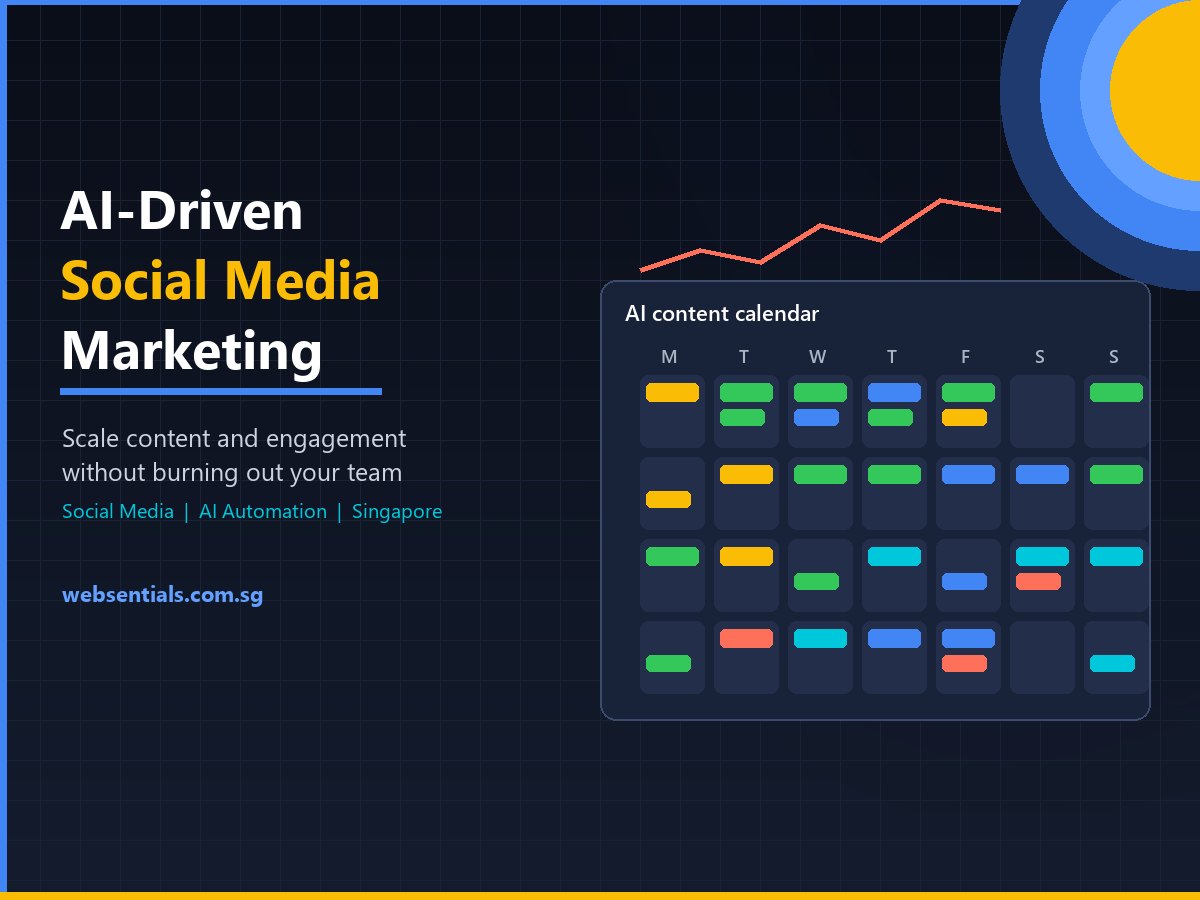
AI social media marketing helps brands keep up with relentless content demands by forecasting trends, drafting content calendars and generating ad creatives, so your team can scale engagement without burning out. Here is how Singapore businesses are putting it to work.
The Content Burnout Problem Facing Social Media Teams
The modern social media landscape never slows down. The average user now spends 2 hours and 21 minutes a day on social platforms and uses nearly seven different platforms each month [3]. To capture even a fraction of that attention, businesses feel pressure to operate like full-scale media publishers.
The traditional answer, throwing more human effort at the problem, is failing. Social media marketers face a hidden burnout crisis, with over 40% planning to leave their jobs within two years because content demands are unsustainable [4]. The constant pressure to ideate, design, schedule and analyse content across Instagram Reels, TikTok, LinkedIn and Facebook leads to fragmented strategy and diluted brand impact. Nearly 40% of marketers plan content only a week ahead because they lack the bandwidth for anything longer.
The fix for this bottleneck isn’t hiring more junior staff; it’s building Artificial Intelligence into your core workflow. The global AI in social media market is projected to reach US$70.53 billion by 2034 [1], precisely because it solves the volume and velocity problem.
With a modern approach to social media marketing in Singapore, businesses use AI to forecast trends, automate creative production and optimise posting schedules, leaving human marketers free to focus on strategy and community building.
Traditional Content Execution vs. AI-Driven Execution
| Workflow stage | Traditional manual approach | AI-driven approach | Business impact |
|---|---|---|---|
| Trend forecasting | Reactive: jumping on trends after they peak | Predictive: AI flags rising trends early | First-mover advantage and more algorithmic reach |
| Content ideation | Highly manual and prone to creative block | A 30-day calendar drafted in minutes | No more “blank page”, more consistent output |
| Visual assets | Costly shoots and slow design tweaks | An estimated 71% of social images now involve AI in production [2] | Lower production costs and faster A/B testing |
| Copywriting | Hours writing platform-specific versions | One core message adapted for five platforms instantly | Consistent tone of voice across every channel |
| Burnout risk | Very high (a constant treadmill) | Lower (AI handles repetitive production) | Less turnover, more time for strategy |
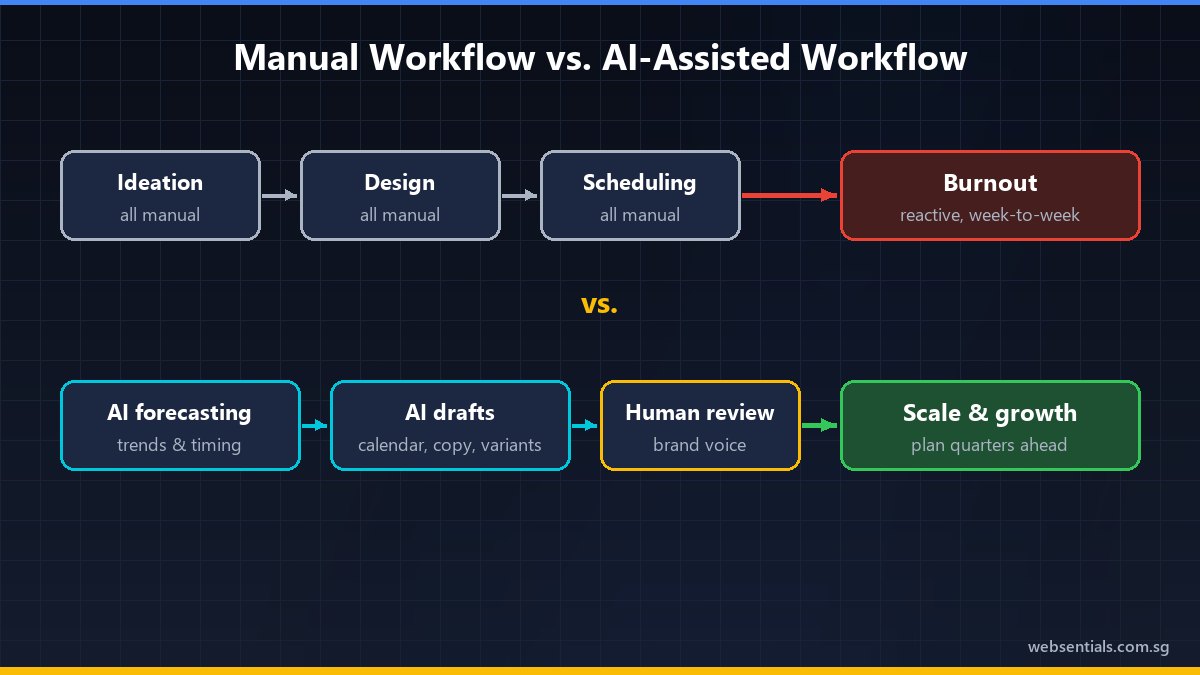
How AI Automates the Social Media Content Pipeline
When you partner with a modern social media marketing agency in Singapore, the strategy shifts from manually pushing content to AI-orchestrated publishing. Here is how AI is used in practice to scale your brand.
1. Predictive Analytics and Trend Forecasting
Marketers used to rely on gut feeling or delayed analytics reports to see what worked. Today, AI uses predictive analytics to anticipate audience behaviour before a campaign launches.
Machine learning models process huge datasets, analysing posts, sentiment shifts and engagement patterns in real time. That lets AI alert your team to emerging topics, viral audio or shifting consumer sentiment before they go mainstream. Instead of reacting to yesterday’s news, your brand creates content for what your audience will look for tomorrow, which is essential on fast-moving platforms like TikTok and Instagram Reels.
2. Eliminating the “Blank Page” with Generative Content Calendars
The sheer volume of content required is the main driver of marketer burnout, and building a fresh 30-day calendar every month is exhausting.
AI language models help through structured ideation. Give an AI tool your brand pillars, target audiences and upcoming launches, and it can draft a full multi-platform content calendar in seconds, with themes, formats (for example, “carousel on Tuesday, short-form video on Thursday”) and draft captions.
A human marketer still reviews and refines the output, but AI does the heavy lifting of first-draft ideation. This kind of AI process optimisation lets teams move from planning week to week to planning quarters ahead.
3. Rapid Generation of Ad Creatives and Variations
Paid social needs constant A/B testing to keep cost per click (CPC) low. If a designer has to build 20 versions of a Facebook ad by hand, the whole campaign slows down.
Generative AI tools have changed how visual assets are produced. They handle background removal, style transfer and upscaling, and they can create dozens of image variants for testing. When one colour palette or layout clearly outperforms the rest, more creatives can be produced in that winning style, so your ad spend always goes to the strongest assets without round-the-clock design support. The same discipline applies to search ads; see Maximizing ROI: Why You Need Professional Google Ads Management.
4. Real-Time Sentiment Analysis and Community Moderation
Engagement doesn’t end when a post goes live. Monitoring comments, answering direct messages and tracking brand sentiment across platforms is a 24/7 job.
Natural Language Processing (NLP), which accounts for nearly 42% of the AI in social media market [1], is now standard for community management. AI tools analyse the emotion and context of incoming comments. An angry review gets flagged for immediate human attention, while routine questions about opening hours or shipping can be answered instantly by an integrated tool like the Websentials Omnibot. Your reputation is protected and your team gets their weekends back. To see how chat automation works more broadly, read our AI chatbot guide for Singapore businesses.
Frequently Asked Questions
Will using AI make my brand’s social media sound robotic or generic?
Only if AI is used badly. The goal isn’t to replace human creativity but to give your team a capable assistant. AI is best for brainstorming structure, drafting variations and analysing data. A successful strategy still needs a human marketer to add the final brand voice, cultural nuance and authentic personality, especially for a multicultural audience like Singapore’s.
How does AI actually help with social media advertising?
AI makes social advertising more efficient through personalisation and rapid testing. Algorithms analyse user behaviour to work out when a particular audience is most likely to click. AI can also generate dozens of visual and copy variations instantly and test them against each other to find the lowest cost per acquisition (CPA), work that would take human media buyers weeks.
Can AI generate video content for platforms like TikTok?
Yes. Around 31% of marketers now use AI tools to help create short-form video [2]. Full text-to-video generation is still maturing, but AI is widely used for editing, automatic captions, audio syncing and cutting long-form content such as podcasts into short clips for TikTok and Instagram Reels.
Scale Your Social Presence with Websentials
Trying to win at social media through sheer willpower leads to stalled growth and burned-out teams. The future of brand engagement belongs to businesses that combine human creativity with AI-driven execution.
At Websentials, we use AI tools to extend your reach without compromising authenticity. We build the content pipelines, set up the predictive analytics and manage the automated engagement that turns your social channels into predictable revenue drivers. For how social fits into a wider plan, see our complete guide to digital marketing agencies in Singapore.
- Audit your content strategy: we will identify where AI can remove bottlenecks in your current social media workflow.
- Explore AI automation: discover how our AI solutions can scale your ad creatives and trend forecasting.
- Deploy smart community management: see how the Websentials Omnibot can handle 24/7 customer engagement on your social channels.
Stop letting the content treadmill dictate your marketing strategy. Contact the Websentials team today to scale your social media presence intelligently.
References
- Fortune Business Insights: AI in Social Media Market Size, Share & Growth Report, 2034
- theStacc: AI Social Media Marketing Statistics 2026 (50 Facts)
- Planable: 121+ Social Media Statistics to Know (2026)
- Fast Company: Social Media Marketers Are Facing a Hidden Burnout Crisis