Digital Solutions Specialist Singapore

What is Agentic AI? Automating Your Singapore Business Workflows
July 13, 2026
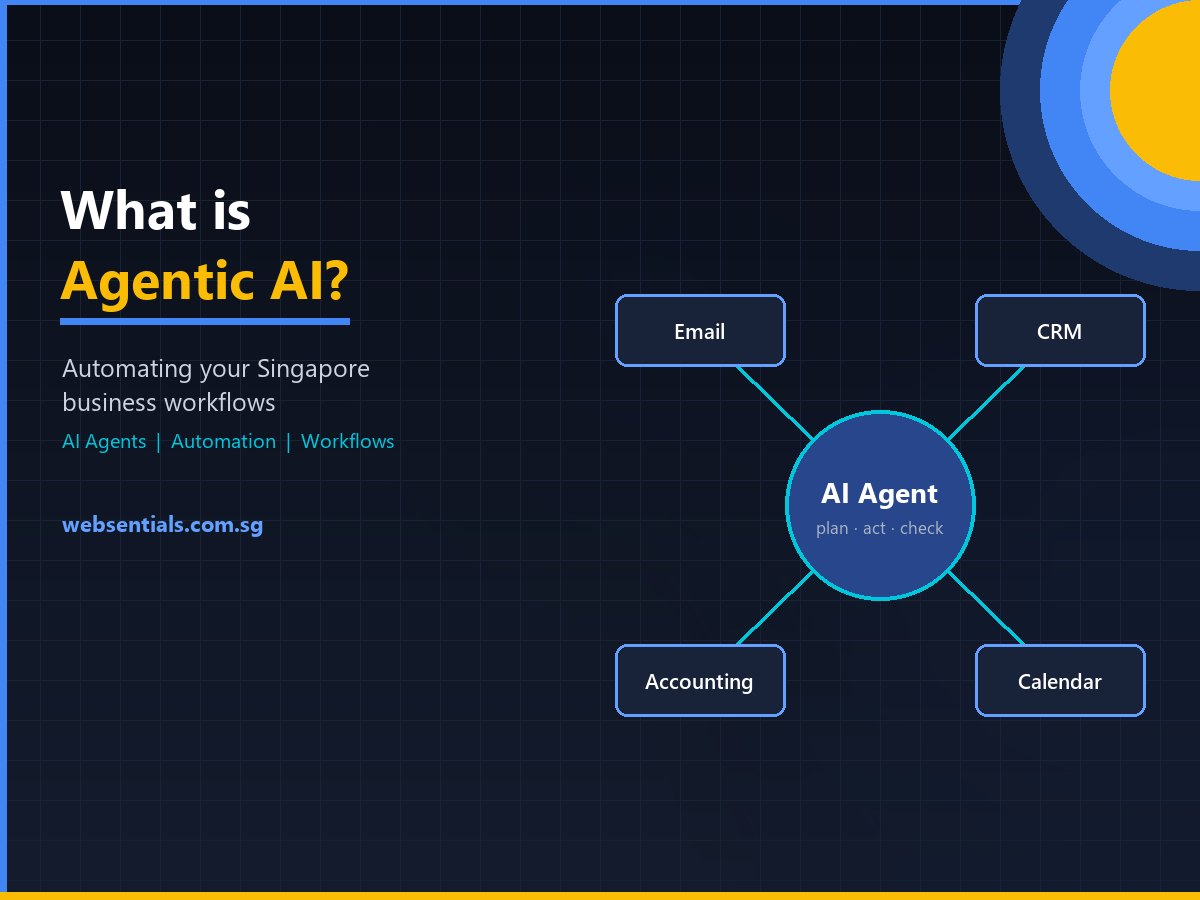
Agentic AI refers to AI systems that don’t just answer questions: they plan, decide and take actions across your business tools to achieve a goal, such as processing an invoice, qualifying a lead or resolving a support ticket. For Singapore businesses, it’s the next step beyond chatbots, turning AI from an assistant into a digital worker. Here’s what it is, how it works and where it delivers the most value.
From Chatbots to Agents: What’s Changed
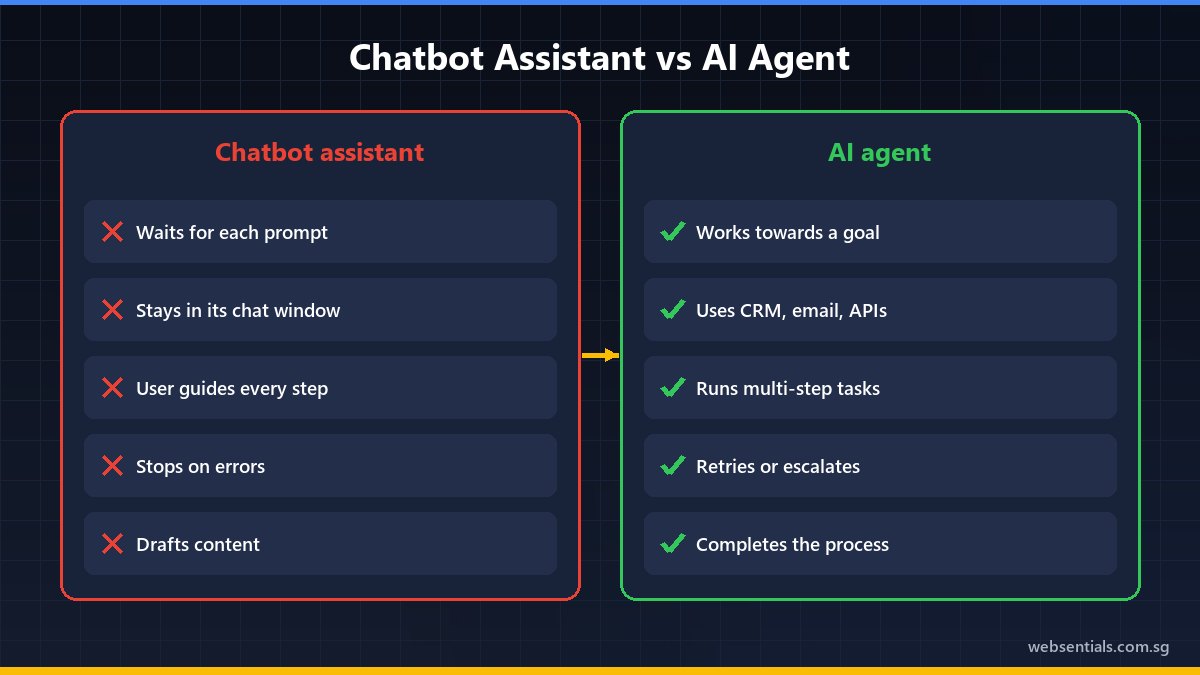
For the past few years, businesses have focused on generative AI and chatbot interfaces. However advanced the underlying large language model (LLM), a standard AI assistant is reactive: it analyses, drafts and recommends, then waits for a person to act on its output. If you want that recommendation entered into your CRM, sent as an email or turned into a multi-step plan, an employee still has to bridge the gap.
Agentic AI changes that. Agentic systems have “agency”: the ability to break a high-level goal into smaller tasks, use external tools (APIs, databases, business software) to carry them out, and adjust if something goes wrong along the way [1]. For Singapore businesses looking to streamline operations, agentic AI solutions are becoming a practical way to cut repetitive manual work.
Generative AI Assistant vs. Agentic AI
| Capability | Chatbot / GenAI assistant | Agentic AI system | Business impact |
|---|---|---|---|
| Mode | Reactive: prompt in, response out | Goal-driven: plans and acts | Less hands-on supervision of routine tasks |
| Tool use | Limited to its own chat window | Works with APIs, CRMs, ERPs and databases | AI acts inside your existing software |
| Multi-step tasks | User guides each step | Works through sequences on its own | Faster end-to-end processes |
| Errors | Stops and waits | Recognises issues and tries alternatives, or escalates | Fewer stalled tasks |
| Value | Drafting and research | End-to-end process execution | AI moves from assistant to digital worker |
How AI Agents Work in Practice
It helps to separate three things. A model that only answers questions is generative AI. A script that runs the same fixed steps every time is robotic process automation (RPA). A system that decides, acts and adjusts across multiple steps to reach a goal is an AI agent.
An agent typically uses an LLM as its “orchestrator”, cycling through perceiving the situation, reasoning about the next step, acting with a tool and learning from the result [2]. Take incoming supplier invoices. An agent can open the email, extract the invoice details, check your accounting system for duplicates, match the purchase order and enter the data. If a required field is missing, it can email the supplier for clarification, and flag anything unusual for a human to review.
Where Agentic AI Delivers the Most Value
AI process automation pays off most on processes that are structured and repetitive but consume a lot of staff time.
1. Customer Support
Traditional chatbots frustrate customers with rigid decision trees. AI agents can look up order or account information, take routine actions and hand complex cases to your team with full context. Tools like Websentials Omnibot already answer customer enquiries across channels around the clock and escalate to staff when needed. Read more in our AI chatbot guide for Singapore businesses.
2. HR and Recruitment Admin
Scheduling interviews and screening applications take up a lot of recruiters’ time. An agent can check interviewers’ calendars, propose times to candidates, update your applicant tracking system and send onboarding materials, while hiring decisions stay with people.
3. Sales Operations and Lead Research
Agents can research prospects, summarise recent company news, update CRM records and draft personalised outreach for a salesperson to review. This complements tools like Sales Pathfinder, so your team spends more time selling and less on data entry. We covered how these tools fit together in Beyond Chatbots.
4. Low-Code Orchestration
Building agents once required specialist engineers. Low-code orchestration platforms now let teams define workflows, set permissions (for example, read-only access to payments but read/write access to the order system) and add approval steps. The challenge shifts from pure engineering to workflow design and governance: deciding what agents may do, checking their work and expanding their scope as trust builds.
Frequently Asked Questions
What is the difference between generative AI and agentic AI?
Generative AI creates content, such as text, images or code, in response to a prompt, then stops. Agentic AI builds on generative models by adding the ability to plan and use tools: it can search, query systems, process the results and take actions in other software to reach a defined goal.
Is it safe to connect AI agents to business systems?
It can be, with the right controls. Give agents only the permissions they need, log what they do, and require human approval for high-impact actions such as payments or data deletion, at least until their behaviour is proven. Security and governance should be designed in from the start.
Which workflows should we automate first?
Start with high-volume, repeatable tasks with clear rules, such as invoice matching, enquiry triage or appointment scheduling. Keep tasks that need judgement, negotiation or empathy with your people.
Put AI to Work with Websentials
Moving from manual workflows and basic chatbots to agentic automation can be a real competitive advantage, but reliable, secure AI pipelines need careful design. At Websentials, we build AI solutions around the way Singapore businesses actually operate.
- Audit your bottlenecks: we’ll identify manual processes that are good candidates for automation.
- Explore our AI solutions: from Omnibot to custom workflows.
- Ask about grant support: eligible SMEs may be able to offset part of the cost of a pre-approved GenAI chatbot solution.
Contact the Websentials team today to explore your first AI agent.
References
- IBM: What is agentic AI?
- IBM: What are AI agents?