Online courses promise flexibility, but for busy small business owners, that flexibility can quietly become the reason a course never gets finished. Grace Chia’s success story is a good example of the opposite approach working better — an in-person course with a fixed schedule that she actually stuck with, and used.
The Problem with “Learn AI in Your Own Time”
Self-paced online courses ask learners to supply their own accountability, on top of everything else running through their week. For a small business owner already juggling operations, sales, and customer service, that’s often the first thing to slip. Grace had tried a couple of free online AI tutorials before enrolling with us, and — like many small business owners — never got past the first module.
What Changed with an In-Person, Fixed-Schedule Format
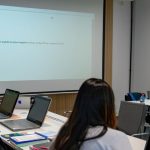
A scheduled classroom session works differently: there’s a date on the calendar, a room to show up to, and other learners in the same boat. That structure alone solved most of the completion problem. Beyond attendance, being in the room with an instructor meant Grace could ask questions specific to her business — a bakery — rather than working through generic examples that didn’t map to her actual content needs.
Direct Instructor Feedback Made the Difference
One advantage that’s easy to underrate until you’ve experienced it: real-time feedback. When Grace drafted a product description using AI for the first time, she got instructor input on tone and accuracy in the moment, rather than guessing whether her output was good enough. That kind of immediate correction is difficult to replicate in a pre-recorded video course, no matter how well produced.
Networking with Other Learners
A less obvious benefit of in-person classes is the peer learning that happens between sessions — comparing notes with other small business owners in the room, seeing how a retailer or a service provider was applying the same AI techniques differently. Online courses, by contrast, tend to isolate learners inside their own screen.
The Course Behind the Story
Grace completed the WSQ Transforming Content Creation with AI course, which is delivered entirely in person for exactly the reasons above — consistency, accountability, and direct feedback tend to matter more for finishing a course than flexibility does.
Funding Made It an Easier Decision
Cost is often the real blocker for small business owners considering training, and funding support was part of what made the decision easier for Grace. Given that WSQ-accredited courses can be supported through SkillsFuture schemes, it’s worth taking the time to check your SkillsFuture funding eligibility before assuming a course is out of budget.
Is In-Person Right for You?
If you’ve started (and stalled on) online AI tutorials before, or you simply learn better with a live instructor and a fixed schedule, Grace’s experience is a useful data point. It doesn’t mean online learning never works — but for busy owners with limited spare hours, a structured classroom format often produces a better result simply because it gets finished.
What Grace Would Tell a Business Owner Considering the Course
When asked what she’d say to another small business owner weighing up the course, Grace’s answer was simple: stop trying to teach yourself in the gaps between everything else you’re already juggling. She’d spent months meaning to “figure out AI properly” and never getting past a first attempt, largely because there was no fixed point in her week set aside for it. Booking an actual class, with a start time and an end time, turned something vague and ongoing into something finite and finishable.
How the Skills Carried Over Into Daily Business Use
The real test of any course is what happens after it ends. For Grace, the biggest shift wasn’t a single dramatic change but a steady reduction in how long routine content tasks took — product descriptions that used to take twenty minutes now take five, because she has a repeatable process rather than starting from a blank page each time. That kind of compounding time saving is often harder to notice in the moment than it is looking back after a few months.
Why This Matters Beyond One Success Story
Grace’s experience isn’t unique to her business — it reflects a broader pattern among small business owners who try to build new skills around an already-full schedule. Structure and accountability tend to matter more for follow-through than raw motivation does, which is part of why in-person, scheduled formats consistently show up as a better fit for busy owners than open-ended, self-paced alternatives.
What Other Small Business Owners Ask Before Enrolling
A recurring question from prospective learners is whether the course will feel too generic to be useful for their specific business — a fair concern, given how broad “AI content creation” sounds on paper. In practice, the in-person format is what solves this: because an instructor is working with learners in real time, examples get tailored to each person’s actual business rather than staying abstract. A retailer, a service provider, and a food business in the same room will each walk out with content examples relevant to what they actually sell, not a one-size-fits-all template.
Balancing the Course Around a Busy Schedule
Owners understandably worry about fitting a course into an already tight week. What made this manageable for Grace wasn’t finding extra hours out of nowhere — it was that a fixed class schedule forced a clear decision about when the time would come from, rather than leaving it as a vague intention to “find time eventually.” That single shift, from open-ended intention to a scheduled commitment, is often what separates a course that gets finished from one that quietly gets abandoned.
Frequently Asked Questions
What kind of business does Grace run?
Grace runs a small bakery business and uses AI primarily for product descriptions and social content.
Is this course only useful for retail or F&B businesses?
No — the course applies to any small business that regularly needs written content, regardless of industry.
How much time per week does the in-person format require?
Time commitment is confirmed at enrolment based on the current intake schedule.
Can I switch from a self-paced online course I’ve already started?
There’s no formal transfer process, but many learners enrol after finding online self-study didn’t stick for them.
Does the course include one-on-one feedback, or only group instruction?
Sessions are group-based, with instructors also available for individual questions during and after class.
How soon after finishing the course did Grace start seeing results?
Grace noticed a difference within the first few weeks, mainly in how much less time routine content tasks took once she had a repeatable process to follow.
Did Grace need any prior writing or marketing background?
No — Grace came from an operations background with no formal marketing training before enrolling in the course.
Would Grace recommend the course to another solo founder?
Yes — she’s specifically pointed other small business owners toward the in-person format after her own experience with unfinished online tutorials.
Is the classroom format suitable for someone who’s naturally shy about asking questions?
Many learners share that concern beforehand, but small class sizes and a practical, example-driven format tend to make questions feel low-stakes rather than intimidating.
Read Grace’s Full Story
For the complete account of Grace’s experience, visit Websentials Academy and read her full success story.
REFERENCES:
- SkillsFuture Singapore. (2026). Who WSQ Is For. SkillsFuture Singapore. https://www.skillsfuture.gov.sg/initiatives/mid-career/who-is-wsq-for
- SkillsFuture Singapore. (2026). SkillsFuture Credit. MySkillsFuture. https://www.myskillsfuture.gov.sg/content/portal/en/career-resources/career-resources/education-career-personal-development/SkillsFuture_Credit.html